Saturday, July 23, 2011

Emery Bardock off to Simon Fraser University

We first met Emery when she was just a teen, and the Kal Tire Junior Linkster Tour played Highlands Golf as part of their Okanagan circuit.

She's all grown up now, and this September is off to join the highly-touted golf team at Simon Fraser University in Vancouver.

Emery Bardock, all grown up    
Emery shot a 61 at Highlands today..."...took a double on number seven", she grinned, adding "great practice for my short game."

As a youngster, Emery participated in the Junior Linkster Tour under the leadership of Scott Harnett.

We'll be watching for your success at SFU, Emery!

Monday, July 4, 2011

Premier Christy Clark and the Liberals damaging Small Businesses

Occasionally a compelling Letter to the Editor warrants reprinting.

Mr. Jeff Wuolle--a small business owner in the North Okanagan--wrote the following, printed in The Morning Star on Sunday, July 3, 2011.

"Small business takes a hit, again
I had to wait so I could collect my thoughts on your most recent action plan announcements contained in The Vancouver Sun, in regards to the food and beverage industry being required to provide nutritional information on menu lists.  This, Madam Premier, is the final straw for many small businesses.

I am going to list some salient points that you and your cabinet members just don't seem to comprehend or deem important enough to consider.  I am but one operator in this province who is feeling the onerous and excessive weight of your policies while you pander for the votes of the general populace.

Since HST was introduced (Ed.note:  July 1, 2010), or should we say shoved down our collective throats, I have experienced the following:
  • Closed one of our three operations and reduced our workforce by seven staff members at a payroll impact of over $85,000, plus their spending in the local economy of a 2.5-to-1 ratio impact as an economic generator.
  • Returned our provincial liquor licence at a loss to the province of liquor tax and HST.
The increase of the minimum wage, while justified, could have been spread out over a longer impact period.  While I currently pay well over the new pay scales, I have now been approached by some staff to ascertain my plans to increase their wages because "they are now experienced staff members."

The possibility of your raising the small business tax by two per cent to cover the HST rebates to the general populace, and of course, that tax increase may never be rescinded in the future.

The ongoing increases in operating costs experienced daily (that are almost impossible to pass on daily to our customers and would they pay the rising costs anyway?) -- food, B.C. Hydro, telephone and all other operating expenses.  Oh, and let's not forget the increasing municipal costs from taxes to water to utilities, local assessments and on and on.

All of this while indexed pensions, salaries and expenses to our elected officials carry on unabated.

And then recently, I am being told that you are going to require nutritional contents on menus.

Notwithstanding daily efforts to provide home-cooked quality, meals and baking, we also provide all information that we have available when infrequently requested to do so.

The cavalier attitude of the president of the B.C. Restaurant and Foodservice Industry that "it only costs $500 per menu item to have your menu analyzed for content" is absolutely a ridiculous scenario.

As of today, that would be approximately $32,000 to cover off our basic menu items, not including ongoing daily specials and other products.  The upside, of course, would be that it would generate additional revenue for you to so wisely spend in the province.

Our industry sector is being flagellated to death with your policies and taxes.  I and everyone else would like to know where you and your staff are obtaining information that proves we have recovered from our recent recessionary economy, to the degree that we should be inundated with additional costs at this time?  I would dearly love for you to take some time out of your schedule and come put on a small business owner's hat for just one day and experience the pleasure of currently conducting business in this province.  Have you even asked about the number of food and beverage operations that have closed or are on the edge of the abyss of doing so?  How much are you and your colleagues prepared to pay for your daily food intake, without it coming out of taxpayers' pockets through reimbursed expenses?

As you slowly but inexplicably grind the provincial economy to a halt, I and most others would like to know when you will step back from these cavalier policies and also take your hands out of our financial pockets?"
Jeff Wuolle

"I don't need nutrition info on my kibbles," suggests Kia.

Thanks, Kia.  
And thanks, Jeff Wuolle, for perfectly expressing my own feelings as a small business owner.  The province's new Premier continues to shift policies decidedly to the left.

Thursday, June 16, 2011

10 kW Wind Turbine Running Again

After 4 months and 4 days of downtime due to 2 blown 6 kW Power One inverters, we're back up and running today.

Add to that the 2 months it was down in 2010, and that adds up to 25 per cent downtime in two years.


Paul Wende, Energy West, installs the two new Aurora 6 kW inverters
And the problem?

"A loose bolt on the heat dump," says Paul.

In the Roses and Thorns department,  a bouquet of Thorns to Power One in California for the horrendously slow response from their Customer Service department.  After more than 3 months of back and forth--with no decisions forthcoming on inverter failure and replacement--Paul contacted the Vice President of the company.  Obviously the VP had the authority to make the decision, whereas others did not.

Wednesday, June 8, 2011

New Inverters en route from California!

Four days from today, we're at 4 months turbine production downtime (plus two months last year), so it was good to hear Paul Wende report that two new inverters were on their way from Power One in California.

"It took an hour on the phone with Power One's vice president of Global Renewable Energy group to discuss the inverter issue and Power One's customer service," advises Paul.

The vice president made the correct decision. 
Customer service dragged their heels.
Sales/warranty dragged their heels.

So the morale of the story is "start at the top, not at customer service" admonishes Kia.

And I'll cease calling them Power None...promise!

It'll be good to be up 'n running...again.

Now if only British Columbia's net metering system wasn't such a sham!

Monday, May 2, 2011

Coldstream Councillor Gyula Kiss needs a Dictionary

It could be pre-election posturing by Councillor Kiss.
It could be that he needs a refresher / reminder of historical water decisions here.
Or get a dictionary and look up what subsidy means.

Or maybe he just needs to believe Al Cotsworth, water utility manager, when Al stated "These six businesses don't need treated water," referring to the fact that chlorinated water is all that is available from the water utility to two golf courses (one of which is Highlands Golf), two nurseries, a light manufacturing facility that uses water for cooling, and a tourist attraction. 

Councillor Kiss' objection to the six businesses being billed about one-third of the cost the public is levied could be an attempt to garner residential votes for the November election.

Or maybe he needs a reminder that in 2005 we six businesses were faced with (former Vernon mayor) Sean Harvey's demand to the North Okanagan Regional District board that the non-potable commercial irrigation water category be eliminated in its entirety.  We six companies obtained a solicitor's services to represent us at the NORD board meeting and proved that while other communities were increasing the number of categories based on their users' needs, then-Mayor Harvey sought to reduce this area's to two:  "residential or farm", he was quoted as saying.  Ultimately the Board voted down Sean Harvey's request.  And ultimately Vernon elected a new mayor.

Now, six years later, the rest of the Board today seems tongue-tied, and Councillor Kiss' admonishment "(other) commercial and domestic customers are subsidizing the use of this water," was printed in The Morning Star on April 24, 2011, under the heading Water Use Charges Questioned

Okay, Councillor Kiss, so you want to talk about subsidies?

Pull up a chair and listen.
Highlands Golf C-5 commercial zoning is calculated by your Council as a multiplier of the residential rate of 2.95 to 1.
Highlands Golf pays three times the mill rate of residential property taxes.
Does that meet Councillor Kiss' definition of subsidy?

And until recently (before C-4 screamed bloody murder), major industry paid four times the residential rate.  The district of Coldstream is striving to reduce the class 4 tax rate by 2.5% per year in future; likely because they want to prove communities aren't built "on the backs of business". 

You also may be interested, Councillor Kiss, that Highlands Golf received a letter from NORD dated March 7, 2011, that confirmed this property's annual irrigation use and maximum flow available based on this property's allocation.  In 2010, irrigation water totalled 2,117 cubic metres.  The allocation on this property is -- are you still listening, Councillor Kiss? -- 22,275 cubic metres. 

As your "subsidy" comment proves you need help with math, Councillor Kiss, allow me to spell it out for you this way.
In 2010, Highlands Golf used less than one-tenth of its annual water allocation.
Yup...one-tenth.

I'd say that was damn commendable.

Back to golf courses.  Let's compare golf course water sources and competition for the retail golf market.
Of 15 golf courses surveyed by NORD research in 2005 in an area covering about 100 miles, only two (Hillview and Highlands) are on a metered system through the Greater Vernon water utility.  Predator Ridge and Vernon Golf are on meters, but use spray effluent, under contractual low-cost agreements with the city.  Seven other golf courses--including Royal York in Armstrong--are on "self" (wells).  The same is true of the two nurseries here:  Swan Lake and Art Knapp are on Greater Vernon water utility, while their competition (Bylands) is on a flat rate in Westbank.

So has it now come down to a case of wishing we had built our commercial facilities in another jurisdiction?
We commercial irrigation users would've been treated considerably better in Armstrong, Kelowna (both Glenmore and Black Mountain districts), Spallumcheen, Salmon Arm, Kamloops, Osoyoos and Westbank. 

Thirty-five years ago--when water allocation began to be purchased for the property that would one day feature Highlands Golf--taps spewed beige water, sometimes even containing lumpy organic debris.  Perfect for irrigation.  Today, irrigation water is chlorinated and additional demands by Interior Health to disinfect water at the new treatment plant is still "on the table".  The Greater Vernon Water Utility has plans to separate drinking water from domestic via dual lines, but the earliest (and unlikely) forecast for separation is 2015.

I'll happily bet a water official that separation does not occur by 2015.

And I'll also bet that Councillor Gyula Kiss will not regain his council seat in the November municipal election in Coldstream.

And I bet the other five commercial ventures wish they had located elsewhere.

"So we're moving?" queries Kia.

It's difficult to move a golf course.
But six-to-one say Councillor Kiss should move out of his director and councillor seats if he continues to lean whichever way the wind blows that week.

Thursday, April 21, 2011

Coldstream Council's Surprise Tax Spike

Even Council is surprised.  Imagine that!

Coldstream Council is surprised the 0.7 per cent tax increase has "nearly doubled to 1.35 per cent", as reported in Wednesday April 13, 2011, Morning Star under the heading "Coldstream tax rate takes sudden spike."

"It was really a surprise," said Councillor Maria Besso, after staff presented the rate which is necessary to cover a drop in assessment values.

Apparently the unexpected doubling of taxes is necessary to achieve the same revenue targets as in the adopted financial plan.  "It would have cost us so much more in staff time," (to revisit the financial plan) said Besso.

Perhaps business could adopt that approach.
It'd save me time too, as it does their staff.

Lemmesee...expected annual revenue "x", divided by the number of golfers "y" gives total "A".

So, a decrease in number of golfers annually naturally means that each golfer should pay more per round to meet annual revenue projection.

What a novel idea.
Charge more per person, and always get the revenue you want.

Councillor Besso concludes, however, "if there was a huge outcry, then we'd have to eat crow."

"I can offer a Magpie," suggests Kia, "they taste the same as crow."

Friday, March 25, 2011

Kia's Lonely Winter Ends

...and she's ecstatic to see her friends again, despite the cool and wet weather.

Ione and Lynda braved the chilly weather to golf today while Kia waited for their return at the clubhouse.


"Oooh, that feels so good, only friends know how to rub my back." admits Kia.

Friday, March 18, 2011

2011 Golf Season

Forty-nine calls on the answering machine this week...
Tournament bookings coming in.

Okay...okay.

Highlands Golf will open for public play on Thursday, March 24th.

Men's Nite Tuesdays will begin on April 12th. 

"Golfers should wear two gloves," advises Kia, "It's still cool out there."

Tuesday, February 22, 2011

10kW Wind Turbine 0, Storm 2

Twice in one-and-a-half years.

A mammoth windstorm during Saturday night on February 12th, 2011 has once again "fried" Power One's 6kW inverters, only this time both inverters were affected.  At bedtime, I noticed windspeed was 58 kph as recorded on the residence's Bios weather station.

Last year's mid-May storm affected only one of our two parallel-wired inverters.  This time it's both.

Energy West's Paul Wende on Monday logged onto the controller software via his laptop.
He checked settings and advised that all were within safe operating ranges, but since the controller of the 10 kW wind turbine has no built-in memory, no record exists of the voltage and RPMs of the turbine.
Controller hardware appeared to be physically unaffected by the night's events.

Paul removed the two Aurora inverter covers and announced both inverters "fried".

Paul Wende investigates


A lot of "soot" inside the second inverter


More "soot" inside the first inverter


Inverters were packed into boxes for return to Power One in California, where an investigation will show inverter logs of the last voltages received.  After inverter damage in May of 2010, a new inverter took two months to arrive, its last log indicated maximum voltages had NOT been exceeded!  The two-month timeframe will likely be repeated in this case.

That wasn't the only damage that night.
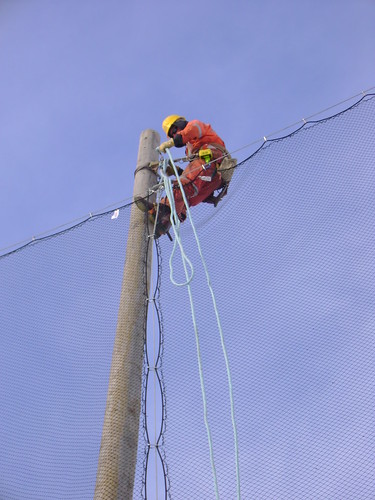
The new nets and poles at the golf course's west fenceline were still standing, but a hardware bolt--holding the aircraft cable on Pole 3--broke, allowing the cable and net to droop.  Advanced Powerline of Kelowna was called and, five minutes later, their crew drove into the driveway.  A crew member chuckled at my stunned look, "we weren't far away when we got the call from the office!"

Jeff, plus two colleagues on the ground, raised the cable.

"Haven't seen one of those hardware pieces break recently, but they did get some bad ones a couple of years ago."  He added, "Maybe you got one of those."

"Have you got a couple of inverters in your office we could borrow?" suggests Kia.

Wednesday, February 2, 2011

Jim Bodkin Letter to the Editor re NORD

Excerpt from The Morning Star, February 2, 2011.

Excellent stuff, worth repeating everywhere!

"The Morning Star front page headline, 'Water rates could soar'  is nothing more than wishful thinking on the part of our local elected officials.  Greater Vernon has some of the highest wter rates in the Okanagan and it is inevitable that these rates will soar well beyond inflation.  Let us all hope that sufficient domestic water is available for purchase regardless of the price.

Two recent decisions by our water officials have decreased substantially the amount of water available for domestic consumption:  1)  the intake on Kale Lake closest to Coldstream Creek has been deemed most suitable for agricultural use and will no longer be used for domestic water, and 2) the 3,000 domestic customers previously supplied from wells have been switched to Duteau water and the well water set aside for agricultural use only.  The rationale given is that it has become too costly to treat water from these two sources to the standard required for domestic usage.

Some of our councillors point the finger at Interior Health but then say not to worry.  They say only 1.2 per cent of our total water comes from wells.  That is true but very misleading because the bulk of our wter is used for agriculture.  Calculating the percentage more appropriately would show that those 3,000 switched well-wtaer customers accounted for a much greater percentage of domestic water usage.

The mega dollars spent on the Duteau Creek treatment plant did not add one drop of extra water to our supply; all the money spent went to making the water coming from the Aberdeen Plateau sources more palatable and less subject to boil water advisories.  The problem is we do not have enough water to satisfy both domestic and agricultural demand except in average or better years of winter snowpack followed by average or better years of summer rainfall.

Our local councillors' growth at any cost mentality is to blame for letting our population growth outstrip our water supply.  We live in an arid climate and approving housing development after housing development has brought us to the point where water restrictions are in place year-round and additional restrictions are necessary in drier than average years.  Only by spending a lot more money to raise dams or drill more wells can we provide water to the 8,000 ready to build home lots already approved by present and past councillors.

The impacts of scarce and expensive water are with us now and the more our population grows the greater the impact will be.  Brown lawns are no big deal; grass has evolved to cope with summer drought and can survive.  The same cannot be said for our urban forest canopy.  Drought stress is becoming more noticeable in residential trees that are no longer being irrigated; it will take them a while to die from drought but disease and insect attack as they weaken will extract an earlier toll.  Some, of course, will cheer the demise of non-native trees but I will mourn their loss of beauty, shade and birdsong.

We taxpayers have and are changing our behaviour to conserve water but we need our politicians to help too by keeping some incentive in the system.  We use less water but then the water purification plant officials decide to raise rates to cover higher per-unit operating costs.  That creates a self-perpetuating no-win situation our politicians need to address.  A good starting point is to look at how officials have loaded long-term water costs onto the front end so we present-day users are being unfairly overbilled today rather than these costs being amortized over the life of the asset.  Fairness means pricing water at the cost of treatment and delivery.  Overcharging for a public good to build up reserves for future use is not how democracy is supposed to work...we all should pay as we go, not a penny more; not a penny less.  For those who have forgotten, we call it responsible government.

Another issue needing councillor action is stopping hobby farmers and country estate owners from using cheaper agricultural water.  Most people agree real farmers earning all or much of their livelihood from growing food deserve lower agricultural rates but hardly anyone agrees that such rates are deserved by fake farmers who are simply taking advantage of a cheap water loophole.

Well-paid officials and councillors collecting stipends from multiple sources need to recognize that many taxpayers are struggling to keep their head above water on fixed pensions, shortened hours and low-paying jobs.  It seems to me that for meaningful change some new "bums" are needed come November elections to replace those overly comfortable in the well-upholstered pews around our council chambers."

Jim Bodkin.

"Why can't our elected officials lower our water costs by charging newcomers with the more equitable and time-tested 'latecomer fees'?" asks Kia.  


After all, we built and paid for the system.
New users should, in effect, reimburse us.

Good question, Kia.
Good letter, Jim. 
Good luck, officials

Monday, January 24, 2011

Water Goes Uphill in the North Okanagan

...Judging by yet another round of rate increases.

On Friday, the Regional District of North Okanagan issued what they term a "preliminary review".

It can't be preliminary if the rates have been enacted and are merely subjec to budget ratification.
And it can't be a review when new rates are taking effect now.

That aside...three areas of water billing are affected:
  1. The first 20 cubic metres--the "allowance"--of water consumption in each of four Quarters is gone.  You will pay 60 cents per cubic metre as soon as the first drop hits your sink.
  2. The Base Fee--the amount you would pay if you used no water at all in each Quarter--has risen to $66.20, an increase of $16.03.  Through 12 months, that equals $64.12 more for not using any water.
  3. Bureaucrats--likely feeling the growing public chill--smartly chose to eliminate the 2010 third quarter surcharge of 18 cents per cubic metre.  Third Q--you know--when it's really really really hot and we need to water more).
  4. Then, just to prove these gougers have left no stone unturned in their search for water...er...a...money, they get you coming or going with the sliding block increases: Block 1 is 0-10 m3 = 60 cents/m3.   Block 2 is 10 (shouldn't it be "11"?) to 40 m3 =75 cents /m3;  Block 3 is 40 (41) to 80 m3 = 90 cents/m3;  and Block 4 is any quarterly usage over 80 (81) m3 at $1.10 /m3.
One cubic metre (m3) equals 1,000 liters which equal 220 Imperial gallons, far too much for one bath unless you have at least a few people sharing that bath with you.

All joking aside, this isn't about conserving a scarce resource--or people's taps would automatically be turned off at a maximum per year usage for that household.  It's about getting the maximum revenue that the public can bear so that the water utility doesn't have to address the slippery issue of having too many engineers on staff.  Engineers who hire work out to other engineers, acting as consultants, so the first engineers can be at arms-length (blame) from decisions that go sideways.

Bureaucratic professionals are overseers, they don't do the work themselves, which adds up to a whopping 45 to 50 per cent of what we pay going to wages and benefits. 

Increasingly, committees of unelected people make decisions that affect you and your family.  You cannot vote them in--or out.  They've been appointed.  Noteworthy in this category is the Okanagan Basin Water Board, who now give grants to communities!  But only if those communities jump through the OBWB's hoops.  Heaven forbid the OBWB would actually focus on something meaty, like increasing reservoir storage at the Duteau plateau for a growing community!   Or Interior Health (beats me why they insist on adding the word "Authority" to that handle, as though they lack clout!)...who are mandating water quality changes that would make Abu Dhabi proud.  But unlike the OBWB, they don't bring a penny to the table.  Neither do they prevent mudboggers and unauthorized access to the Duteau Creek water reservoirs, with nary a sign or improved fencing planned.  Nope, they simply demand what we must do. 

The result of this latest flash through family wallets is that rich people can use all the water they wish--because they can well afford to pay whatever the bill says.  The waning middle class--and poor families--simply cannot conserve the resource any further than they already have, especially today with the focus on growing your own food.  What's next for them?  Not washing clothes?  Not bathing the children?

It'll soon be cheaper to truck water in from Aunt Martha in Winnipeg. 

"We have an Aunt Martha in Winnipeg?", queries Kia.

Thursday, January 20, 2011

VernonCentral.ca

...the only place you'll see videos of Viper Hockey Games and Stars of the Game.

Free classifieds.  Great local restaurant features with Phantom Foodie.  Tips on getting--and keeping--a job.  Hugh and Kathy's Excellent Adventure.  Physio advice. 

And lots more.

Welcome to the community, VernonCentral.ca.

"Any classifieds for dog treats?", asks Kia.

So what do you do all winter?

That's the question I'm asked most often when I run into Highlands' members in town throughout the winter, generally followed by: "...must be nice to have six months off."

Yes, it is nice.
No, we don't go away (bin der, dun dat, as the saying goes).
The world's a different place nowadays, so travel has less appeal for us both.

My reply generally begins with "Do you recall how crowded it was on the patio during golf season?"  People nod in agreement, laughing, when I say:  "I'm making more..."

More what?  Palms.  Palms...oh yes...those lovely, swaying-in-the-breeze and whipping-you-in-the-face thingys on three sides of the clubhouse patio all summer long. 

And there's always room for a few more, so here we go:

Cocos nucifera, under lights during winter


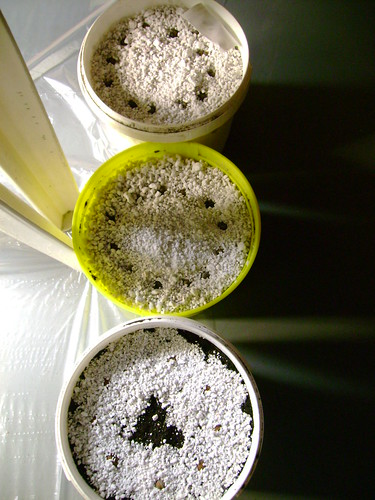
Wodyetia bifurcata (Foxtail palm) seedlings are growing nicely


Nannorhops ritchiana, Pritchardia hillebrandii, Chamaerops humilis   

...with more still to germinate. 


There's also the Trachycarpus fortunei in the heated palm hut to look after.

33+ (yes!) year old Trachycarpus fortunei

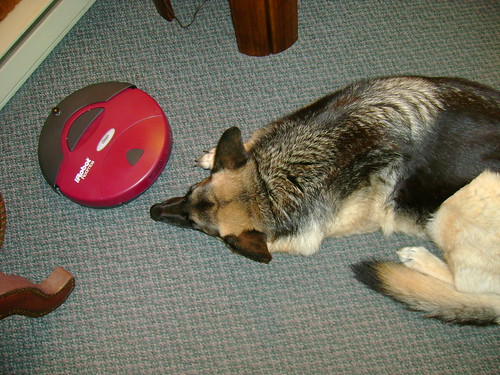
"I'm so bored, I'm waiting for this Roomba to move so I have something to play with," moans Kia.


...winter!  (yawn)
...did you see it move?  think I did...

It'll soon be late-March, and the start of the golf season...

Friday, December 10, 2010

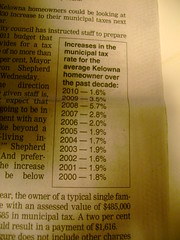
Kelowna's 10-year Tax Increase Record

You'd think Kelowna was in another world...
Yet they're only 45 km south of Vernon and Coldstream.

Excellent story and in-depth research by their community newspaper "The Daily Courier" (issue December 9, 2010).

Why "excellent"?
Because reporter, Ron Seymour, actually informed the public that Kelowna's proposed 2% property tax hike equates to a $30.00 increase in municipal taxes only.
He then writes something that Vernon's Morning Star does not report (and never has)...he concludes:

"This figure ($30.00) does not include other charges that appear on tax notices mailed to property owners...those levies, for such things as the school board, hospital board, and regional district, typically almost double the total tax bill."

Good reporting, good story!  Congratulations to The Daily Courier.

Could our area's residents hope for such worthwhile information in "The Morning Star"?

We can only hope...

"And Kelowna's Mayor, Sharon Shepherd, deserves kudos for her desire to keep the hike at, or below, the cost of living increase," offers Kia.

Residents here can only hope for that too...

Kudos to Kelowna, all the way around...

Monday, December 6, 2010

Coldstream Municipality Spent the least Per Capita

But don't send them a Thank You card yet.
This Mayor and Council have a long way to go before Coldstream is sustainable.

In the province of British Columbia from 2000 to 2008, municipal operating spending (excluding capital expenditures), grew by 57.7 per cent, while population and inflation grew by only 28.7 per cent.

Did anyone hear a little bell go off? 

By 2008, less than one in 10 municipalities (representing only 1.2 per cent of the provincial poopulation) had been able to keep spending growth in line with population and inflation growth for the period studied, reports the Canadian Federation of Independent Business in their B.C. Municipal Spending Watch 2010.

Not keeping spending in line must've been contagious, because Coldstream's spending has grown 60.7% since 2000.

Has population increased by 60%?  No.
Laudable is Coldstream's per capita spending in 2008 ranked lowest in B.C. municipalities for the second year of the study, amounting to $566 (vs. $501 in 2007).
Coldstream's population at 10,320 "just" squeaked into the ranks of communities with a population of 10,000+, which somewhat skews numbers.  To compare, Vernon's spending in 2008 was $995 for each of their 38,400 population.

But before you pat the backs of Coldstream's Mayor and Council, ask yourself (and them) why Coldstream's Fiscal Sustainability Gap (FSG) is so high (more than half of Coldstream's land is locked within the Agricultural Land Reserve, where few--if any--services other than water connections exist). 
  • Coldstream's FSG = 2.91.  Spending increased at nearly three times the rate warranted by population increases and inflation.
  • Vernon's FSG = 2.61.  Spending increased at just over two-and-a-half times the rate warranted by population increases and inflation. 
  • In Coldstream excess spending in 2008 amounted to $1,559,606.  If excess spending in 2008 had been eliminated, a family of four would have saved $618 on their property tax bill.
  • In Vernon, excess spending in 2008 amounted to $10,287,057.  If excess spending in 2008 had been eliminated, a family of four would have saved $1,070 on their property tax bill.
What's Coldstream Municipality spending our money on?
Yes, roads are being repaired; yes, aging infrastructure needs almost constant upgrading.

But we know where approximately half the money goes:
"At least 48 per cent of municipalities’ budgets go to salaries and benefits, with a further 15 per cent going to contracted services," continues the report.

Forty-eight per cent to wages and benefits?
Yup.
The private sector could not survive with those levels, and it should be no different with public sector wages.
The only difference is municipalities simply dig deeper into our pockets at tax time.  Municipalities don't have to sell a product to make money.  When public wage increases are not prudently managed, it distorts local employment markets, reduces productivity, and increases tax levels.

Two years ago when small businesses were asked how satisfied they were with the value-for-money of municipal public services, most small businesses chose "poor" (48%) or "adequate" (37%).
Only 7% said their value for tax money from municipalities it was "good".

Why are businesses so peeved?   
Because small business pays a disproportionately larger share of property taxes relative to property value and services consumed while residents pay a disproportionately small share.

But data collection of public expenditures at the municipal level is poor, admits the study.  That, however, is where Alberta is a leader!  Alberta municipalities must report both the number of employees they have and their salary and benefit spending.  In B.C., only the number of employees is collected voluntarily by CivicInfoBC, and only one-quarter of municipalities comply!

According to a recent CFIB study, small businesses in British Columbia pay, on average, 2.94 times the property tax that residents pay based on the same assessed property value.  This is particularly unfair considering that in many municipalities businesses must pay extra for many services that are provided as part of the tax bill for residents, such as garbage collection.

One thing's for sure:  when public wage increases are not prudently managed, it distorts local employment markets, reduces productivity, and increases tax levels.
Municipal leaders are quick to point out they get only get 8 cents on every dollar of taxes raised by all governments.  However, they don't include that user fees now generate additional revenues equaling (or greater than) property tax revenues.  And since user fees are more times than not charged to existing property owners (applying for renovation permits, parking permits, etc.) this effectively increases even further the taxes portion the user pays!

It's not just business.  Can your family afford to keep paying above the "sustainable level" each and every taxation year?  Are you receiving as much "bang for your buck" as you did in services back in 2000?  In 2001 and successive years?
The answer is likely No.

Short of waiting for the next election what can be done?

Public sector wages must be frozen until they are within 5 per cent of wages for equivalent positions in the private sector.  Statistics Canada data has demonstrated that municipal employees are paid significantly
higher rates of overall compensation than their private sector counterparts.

Municipalities need to focus on core services (clarify via public forum).  And then stick to them!
Residents and businesses alike do not want to have their hard-earned tax dollars spent on cultural or wishy-washy programs.  "Culture is best disseminated by grandparents", intoned a local taxpayer recently, adding "not by some bureaucrat".  The core services issue should really hit home with all of us.  Only in the North Okanagan are levels of government virtually running into one another.  When one level of government infringes on the responsibilities of another level, unnecessary duplications and inefficiencies occur.  The wish of a Coldstream councillor comes to mind -- he wants to have the Lavington Park grass mowed more frequently (than Greater Vernon Services was doing).  Then there's the distribution and billing of water.  And water infrastructure...the list is never ending.  A year later, there are arbitrators and lawyers involved and a plan for a new Mechanic's Shop that just happens to have space for a new piece of equipment...a Coldstream municipality mower for the grass at Lavington Park.  But that's innuendo...jumping the gun, as Coldstream goes to a referendum re borrowing money for the Mechanic's Shop.

Spend, borrow.  Borrow, spend.  And just like the years-ago referendum for borrowing for a new Coldstream Municipal Hall, council has stated that even if the referendum is denied, they'll still go ahead and build the Mechanic's Shop (as they did by building the municipal hall when that referendum was denied by voters).

Begin the process of setting spending limits.  Zero-based budgeting!
Just like business does.
Read last year's CFIB study results here
When it comes right down to it, Coldstream's Mayor and Council should ensure that municipal operating budgets are on a sustainable path, and that all taxpayers receive value for money, not just residential taxpayers.

"But they haven't even adopted the recommendations in last year's report," muses Kia.
 No they haven't.