Showing posts with label tax burden. Show all posts
Showing posts with label tax burden. Show all posts
Sunday, April 7, 2013
18% Voter Turnout at Referendum
And of that 18 per cent, 47.65 per cent said No, with 52.35 per cent saying Yes to borrowing $7.5 million for the Community Sports Facility adjacent to Okanagan College on Highway 97.
The perennial question after any vote is "Did the non-voters (36,875 in this case) favour the referendum?"
Or does the low voter turnout indicate yet more apathy among North Okanagan residents?
People should care, but often don't cast a ballot to support their opinion.
A total of 45,095 were eligible to vote.
"I'd better not hear any whining from any of the 82 percenters who didn't vote," asserts Kia.
The only aspect I'm personally dead against is that tenants--who do not own property--are permitted to vote in provincial borrowing referenda. And companies that operate in the area get no vote. That's the thoughtless manner in which voting rules are applied in British Columbia.
To calculate how much this sports facility will cost your family, here's the residential calculator.
Multiply that by the 20 year term.
And then hope that (municipal) interest rates remain low.


Saturday, March 30, 2013
Highlands Golf open for the season
Great weather (20C) for the Easter weekend.
Opening day was Good Friday.
Nice to see our regular customers again; good to know they're all a year older as well *grin*.
Lots of discussion ensued from the new clubhouse sign:
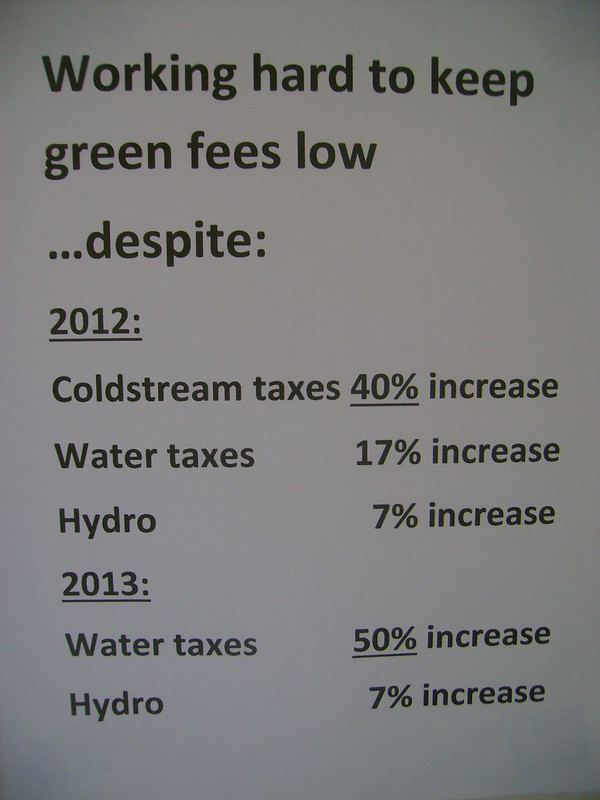 | ||||||||
| 3 levels of government, all within a 5-minute drive, lead to huge and burgeoning bureaucratic costs in the North Okanagan of B.C. The 2013 property tax increase is 4.12% |
The majority involved getting rid of government(s).
"I'd tend bar if I could," offers Kia.
Thursday, February 28, 2013
City of Vernon Taxes
When will this ever slow down? reads the heading.
Obviously a rhetorical question, posed by yet another resident in a Letter to the Editor.
Garry Haas is another in a long string of residents opposed to tax hikes.
Salient points of his long letter, printed in Vernon's Morning Star on February 27, 2013, follow:
"Well, here we go again, it seems. At first it was 1.8 per cent, now it is 3.95 per cent. Mr. Mayor and council, please make your mind up and listen to the public. We do not want any tax increase.
"Take a look at all of the vacant buildings and stores and think about all of the jobs lost" G.Haas
The assessed value of our property decreased by $20,000 but the mayor says my taxes will increase by $53. That's bad accounting. Because the value dropped, the taxes should decrease. So, I will actually have an increase of around $80 to $100. This is like the old shell game.
...When will this ever end? When the city is bankrupt and has no more residents? I ask the mayor to please tell us what the monetary increase for inside and outside union members will be this year, and how much the benefits will cost us extra this year, and the same for non-union members.
My wife will get .01 this year, maybe. Believe me, if you take the time to look closely at the budget you will see how our money is being misused.
Business(sic) are closing in this town. Take a look at all of the vacant buildings and stores and think about all of the jobs lost and the council still believes that things are not that bad.
Well, there are house prices dropping, full-time jobs disappearing and young families and children leaving.
The demographics of Vernon are not what the mayor and council want us to believe. We are an aging city and it does not show any signs of slowing down." Garry Haas
"It's Mayor(s) and Council(s) that need to slow down," offers Kia.
Thanks to Garry Haas for his compelling letter to the Mayor.
Yet one more that'll be labelled "Ignore".
Friday, February 15, 2013
Coldstream's Confessional
Transparency in government is a sham.
Especially in B.C.
Especially in local governments like the District of Coldstream.
But the District of Coldstream has now gone to confession, and will be absolved of its sins.
Its sins against Mother Earth.
A short news "story"--and that term is used very loosely--in Vernon's Morning Star on February 13th was entitled "Coldstream hits carbon target."
They're hitting something, but it's not climate action.
Apparently thrilled "that we have reached this point," a gushing Mayor Jim Garlick, added "(we) will continue to seek new initiatives for the betterment of our community."
In talking to residents, one thing's abundantly clear.
Residents don't care.
All that's clear is that our Mayor has rung the bullshit meter again.
Because residents can't afford solar panels on their roofs.
They're too tapped out by unreasonable property taxes, burgeoning fees and ridiculously-inflated water charges, with huge increases still to come.
Reducing greenhouse gases. Carbon footprint.
It's not local government's commitment to resurrecting the quasi-failed Kyoto Accord.
It's simply to assuage guilt...our sins against Mother Earth.
Right here in Coldstream.
To not feel so guilty.
Local governments are simply spending our money to kiss up to senior bureaucrats in Victoria, whose plan this is. Under the guise of thinking globally, acting locally, the province of B.C. is ensuring it becomes another California...broke and flailing in the wind, desperate for cash.
Right along with its municipalities and cities.
Complying with Victoria's rules is the only way municipalities can access additional funding for projects (also spearheaded by senior bureaucrats) that are over and above residents' abilities to pay...but Victoria's money comes from us too.
It appears that Maurice Strong has finally gotten his way.
An advocate of the collapse of sinful Western economies, he continues to live in China.
Good place for that treasonous traitor.
Back to Coldstream's solar panels.
We'd all love to have them, but affordability is the issue.
So we're supposed to feel good every time we drive (*grin*) past our municipal hall complex because they have them. And we paid for them.
Of 188 municipalities/towns in B.C., 180 have signed the Climate Action Charter, and Coldstream is one that signed onto the plan devised back in 2008.
Carbon offsetting is a myth, and its cons seldom see the light of day.
Because you simply end up purchasing new manufactured stuff to replace old manufactured stuff.
But Coldstream has bought it, hook line and sinker.
Some of the "initiatives" it undertook--because like everyone else, Coldstream was unable to completely reduce its carbon footprint--were to purchase a hybrid vehicle (yes, that had to be produced in a steel manufacturing facility), green infrastructure "action" plans (whatever the hell that is!), and so on...
So where is there transparency?
How much did Coldstream pay...and to whom...for carbon offsets?
Did Coldstream's bureaucrats show our elected officials the pros and cons of carbon trading/purchasing carbon offsets?
Did bureaucrats suggest to our elected officials that--instead of physically attending myriad meetings--a tangible (and common sense) carbon-reduction benefit would be to participate via video conferencing? Just how much networking is physically lost if three elected officials don't attend the annual UBCM (Union of B.C. Municipalities) meetings in Victoria? None at all.
But they still fly--or drive--to meetings.
Lots of meetings.
All that hobnobbing and airplane-flying and hotel-staying and restaurant-eating is a worthy sin for our elected officials.
The news article closes with "Council adopted a tax revitalization program to support sustainability."
Yup, we know taxes are being revitalized.
And who--or what--is being sustained?
Taxes certainly have a new life, a new vigor.
To the detriment of everything else that could have.
"Carbon offsets is the new derivative," says Kia disapprovingly.
...and just as distasteful.
Thursday, January 31, 2013
I Hate Year-End
...not because it's a few days' work.
Because it's proof of local government's gouging.
"Up, up and away, in my beautiful balloon..."
Sure I knew what I paid in 2012.
After all, I wrote the cheques.
But year end is a chance to see it in black and white.
Or red, or in brackets.In all its ugliness.
That's when the inequities, the unfairness, the lack of justice becomes apparent.
And it's always local government's invoices.
They hope nobody notices their tactics.
Consider water taxes.
I'll cut to the chase and declare that this property's water costs increased by 28% from last year.
Yup...twenty-eight per cent!
Water taxes really get my goat.
And this goat knows they're only blowing smoke up your skirt when they say it's about Water Conservation.There are 4 water invoices for this property: The fire hydrant is billed annually, but the residence, irrigation, and clubhouse are billed quarterly.
Maybe quarterly billings are employed to make it easier for us to pay?
Kinda like paying for your car or fire insurance in installments.
Nah, it's so they can charge you a flat amount PLUS consumption in each Q.
Funny thing...I'm old enough to remember when a basic (minimum) charge was levied only if there was no consumption.
But I digress.
"It's to teach us to conserve the precious resource," you might say.
Bullshit.
Echoing bureaucrats' statements doesn't make it more palatable.
Last year, Highlands Golf irrigation usage was lower than in 2011.
Noteworthy for the previous year is that our irrigation consumption warranted a letter from the Regional District that proved we used only 10% (yes, one-tenth) of our paid-up annual water allocation.
No congratulations, but that's okay.
So we are conserving the water resource.
Yet our total water costs increased by $595.73 over the previous year.
That's why they call it precious.
And they manipulate timing of reading meters to serve their purposes, as in this example from Coldstream.
No date mentioned on when the meter was read.
Is that even legal?
Bureaucrats are the Tails that wag the Dogs, the elected officials.
Bureaucrats use reverse accounting to fill municipal coffers.
Governments decide upfront how much money they want and divide by the number of customers.
Governments extort money from residents with unsavory tactics. Interesting indeed there's an example of how to report such tactics from, of all places, Quebec, that historical hotbed of graft and corruption. Another deals with public sector transparency from Asia, also well-known for underhanded dealings.
Even where a community's population is increasing--and it hasn't appreciably around here--up go the rates.More than inflation, more than taxpayers' wage increases, more than can be justified...ever.
If only business could do that!
So it's increased service that raises rates?
Nope.
An example is the unparalleled gouging for Highlands' private fire hydrant which, in 10 years, has never consumed the "precious resource".
In 2012, the fire hydrant tax was $454.38.
In 2011, it was $383.80.
In 2002, it was $266.00.
And property taxes...in 2012 property taxes increased by 37.8 per cent (yup...thirty-seven point eight per cent) over 2011.
...so I posted a sign in the clubhouse to show that.
Customers expressed outrage and recounted their own tales of local government gouging.
"My kibbles only increased 3 per cent last year," admonishes Kia.
Should've bought Gold in 2005.
Just to keep up with local government's gouging.
It was $518.00 per ounce then.
Monday, January 28, 2013
Fire Hydrant Gouging
Eleven years ago when Highlands started up--as part of the Development Permit's commercial zoning rules--the requisite fire hydrant here had to be situated within "x" (if I recall, it was 75) meters from the clubhouse front door.
To comply, the hydrant was installed approximately 30 meters inside the fenceline, making it a "private" unmetered hydrant. It provides fire protection for myself and my immediate neighbours, as no municipal fire hydrant is nearby to duplicate the service. More than that, my private fire hydrant provides deep discounts for my immediate neighbours as they're now within the three hundred meter distance that fire insurers require as "full" protection.
So each year I get an invoice for my "private 150mm unmetered fire main" from the Regional District of North Okanagan.
What started in 2002 as yet another nuisance tax bill from one of the myriad local governments has, in 2012, culminated in my abject outrage at the ferocity of tax gouging.
The invoice in 2002? $266.00
In 2011? $383.80
In 2012? $454.38!
These invoices appear to be growing inexplicably (my hydrant has never fought a fire, luckily).
So I phoned James dePfyffer at the Regional District to enquire about the "private" designation.
I asked James whether Coldstream is also charged for their private fire hydrants by the Regional District.
Since, like me, Coldstream doesn't own the water.
And like me, they do own the unmetered hydrants on their land (the road rights-of-way).
Maybe it's water ownership. So who owns the water? The Greater Vernon Water Authority, administered by the Regional District of North Okanagan.
Maybe it's hydrant ownership. So who owns the hydrants in Coldstream? The District of Coldstream, also located on their own land...municipal rights-of-way between fencelines and roads.
And also unmetered.
It could therefore be argued that Coldstream's hydrants are also "private".
Possibly successfully argued.
James dePfyffer said: "That's a good question."
"Certainly has nothing to do with downloading of any imaginary services," muses Kia.
The question stands: Is Coldstream also taxed on their private fire hydrants on their land?
The "good" question was never answered.
Saturday, January 12, 2013
Coldstream's Billing Tactics Hitting the Fan
ADDENDUM 3:30 pm POST-PUBLISH:
Oops...sorry!
"Just to clarify, the sewer rate for the year is set using the first quarter readings ie: Jan 1 - Mar 31 each year (or whatever dates DoC actually read the meters prior). " D.McDonald
Sure, water bills are high.
As are sewer charges.
Ever on the hunt for more money from residents' wallets, the District of Coldstream has resorted to inflating your sewer rates by reading the fourth quarter late--adding another week of water consumption--as discovered by Duncan McDonald of Coldstream when he gathered up his bills.
What tipped him off is they showed his household using more water in the fourth quarter, with no change in habits.
Every year.
Always in the fourth quarter.
Something stank in Coldstream.
Proof was when meters were read (which Duncan had noted).
It's the last quarter's water meter readings that determine residents' sewer charges for the year.
Reading water meters 7 or 8 days beyond the end of the last quarter equates to another week of consumption, hence, flushing the toilet!
How convenient this coincidence is for Coldstream's coffers!
Sure, invoices always state the period covered, and the quarters are always stated as ending when we expect them to end...March 31st for the 1st Q, June 30th for the 2nd Q, September 30th for the 3rd Q, and December 31st for the 4th Quarter...365 days a year divided by 4 equals meter readings approximately every 91 days. Except the fourth quarter, which Duncan discovered was ~98 days.
He calculated that one additional week resulted in an additional $70 being added to his annual sewer charges.
"the district has picked up some much needed cash through deceptive practices." D.McDonald
So he contacted the District.
Here is Duncan McDonald's "comment" (placed on this blog's "Developer" article of January 10, 2013).
"Duncan McDonald January 11, 2013
How's this for a pound flesh from potentially each and every sewer customer in Coldstream... different topic (to the Developer story) but related all the same.
Maybe it was only myself who was naive enough to believe that my water and sewer invoices were billed as indicated. I contacted DoC to find out what dates my water meter was read as it seemed we had pretty high usage for the first 8 days of January when the latest bill arrived. I was advised that the billing dates and the actual usage dates were not in sync and our meter had actually been read Sept 4th and again Dec 6th to comprise this latest bill, despite what is clearly stated on my invoice, "Billing Period: 01/10/12 - 31/12/12". Officially, the software DoC uses is apparently not sophisticated enough to reflect each individual users ACTUAL billing cycle. Right.
"I estimate I was overcharged roughly $70 for the year, which isn't a lot of money, but is (was!) mine. Of greater concern is whether or not everyone in Coldstream was subject to this "stretching" of their billing period as well. 3000 users (give or take) overpaying $70 each per year equals a tidy $210K... not bad for doing nothing." D.McDonald.
No biggie except that when I then requested my meter reading dates from the past year they were as follows, according to the email from DoC; 'In your particular case, your water meter was read on December 6/12. Prior to this it was read September 4/12, June 4/12, March 9/12, and December 2/11.'
Dec 2/11 - March 9/11(sic.../12) is 98 days, about 9% longer than an average quarter. Again, this would not matter at all except this is the period that DoC uses to calculate the sewer rate for the ENTIRE year! I estimate I was overcharged roughly $70 for the year, which isn't a lot of money, but is (was!) mine. Of greater concern is whether or not everyone in Coldstream was subject to this "stretching" of their billing period as well. 3000 users (give or take) overpaying $70 each per year equals a tidy $210K... not bad for doing nothing.
My query was very quickly escalated to senior management (Thanks Trev!) who promptly dismissed my query as an uninformed rate payer unable to understand basic mathematical principles. After several emails back and forth they simply ignored me and left their stance as follows (email from Seibel):
""""Your query was not dismissed and I certainly apologize if that is the way it came across. As noted previously, there is a defined process for the timing of the meter reads and this process is applied to everyone the same. There was not a miscalculation of the consumption rates for the 1st quarter 2012 billing cycle as it was based on the meter read taken at that time. I understand your concern with the 7 day variance between a “normal” (or equal) quarterly cycle of 91 days and the 98 days for the 2012 1st quarter read. However our meter reading process was followed consistently and all meter reads obtained under the same approach. There is no definitive way to say that the consumption values were equally incurred over the 98 days and as a result there is no way to validate the figures you provided.
There are many factors that impact the meter reading for the 1st quarter including weather, human resources and functioning equipment (meter reading equipment and obtaining a read from the house meter). Based on the fact that the process was applied consistently for all meter reads in the 1st quarter of 2012 I find no basis to provide a rebate to your account.
Thank you,
Trevor Seibel""""
In reading Mr Seibel's response, it is pretty clear that all residents were subjected to this little cash grab and the district has picked up some much needed cash through deceptive practices. So far, it appears the buck really starts and stops with the utility provider and is not regulated or overseen in any fashion.
I guess I will contact the mayor next, we'll see how that goes!"
"How convenient for Coldstream," admits Kia, "probably why the District NEEDED to hire a chartered accountant."
Coldstream received ~$210,000 over and above what residents owed for sewer!
Mr. McDonald will be interested to learn even that amount is conservative.
Because the Highlands Golf property is on septic ... as are most rural properties in Coldstream.
And rural properties on septic pay sewer charges.
Anybody willing to take odds on the same gouging tactic occurring in Vernon?
And the regional district's septic areas?
No takers...
No surprise there.
Sustaining Coldstream...Nulli Secundus.
Second to none in deceiving residents.
Add it to the list.
Saturday, December 8, 2012
It's that time of year
Ta-ra-ra Boom-de-ay (melodic)
It's tax-increase warnings day.
The first warning (of many over the next four months) appeared today in The Morning Star, headed "Hospital taxes climbing 13.8 per cent", with an amused--or embarrassed--photo of Councillor Dirk providing article symmetry.
"That translates to
$10 an average house."
Doug Dirk, Coldstream Councillor
Residents should dust off the property tax abacus and start with $10.00 as a tax increase. Leave it on the coffee table as the next four months will be chock full of additional tax increase warnings.
This time politicians are starting with something residents (and hospital staff) had been promised--and clamoured for--for years. We have a new hospital and it's apparently now time "to begin paying off the debt."
...despite the two top floors remaining unfinished.
"The beads aren't only for counting...they can double as prayer beads," offers Kia.
The stage is set.
Fade to black, as Kia heads out to find an "average house" in Coldstream.
-------------------------------------------------------------------
Next installment:
Ta-ra-ra Boom-de-ay (melodic)
Parks, Recreation and "Culture" taxes: 1.87 per cent, announced in The Morning Star Dec. 21/12."That isn't enough to buy Coldstream that new mower..." sighs Kia.
Friday, November 16, 2012
Pissing Taxpayers' Money Away
Literally.
The November 13, 2012 Agenda Package for Coldstream Council's meeting included a shocking item under the monthly report of building permits issued.
Seems the Regional District of North Okanagan has received a permit to renovate a bathroom.
So what?, you say.
The value of the bathroom renovation is $200,000.00!
Yes, two hundred thousand dollars.
For a bathroom renovation!
Plus the permit fee.
"That'll be quite the crapper," asserts Kia, wide-eyed.
The November 13, 2012 Agenda Package for Coldstream Council's meeting included a shocking item under the monthly report of building permits issued.
Seems the Regional District of North Okanagan has received a permit to renovate a bathroom.
So what?, you say.
The value of the bathroom renovation is $200,000.00!
Yes, two hundred thousand dollars.
For a bathroom renovation!
Plus the permit fee.
"That'll be quite the crapper," asserts Kia, wide-eyed.
Friday, January 27, 2012
Oblivious to the Obvious
It's 2012 and, since this New Year brought some new faces to municipalities following the November elections, a renewed fervor to fine-tuning budgets appears appropriate.
Those new faces want to prove they deserved your vote.
When the City of Vernon's bureaucrats rolled out their department's wish lists, the potential tax hike of 8.5 per cent likely shocked the newcomers, second only to the reaction of residents.
"We'll be disappointed if we don't knock three or four per cent off," offers newly-elected mayor Rob Sawatzky, reported by The Morning Star newspaper's January 25th issue.
At the risk of giving the newspaper more credit than it deserves, Mayor Sawatzky and New-Crew need simply read the rest of that newspaper's pages (including the political cartoon) to get their toes pointed in the right direction.
But first, let's consider the topics the New-Crew is pondering as they hope to limit increases to "zero to 2.3 per cent": (from Richard Rolke's article) "...renovating the current library for city staff offices, road rehab on 25th Avenue and Silver Star Road, sidewalks on Alexis Park Drive and $80,000 for a core review of city services."
And maybe increasing parking fees.
That ought to immediately have the Downtown Merchants' Association wringing their hands in disgust.
Why?
Because they're already suffering from free parking offered by the big box stores at the North end of town.
Is that what New-Crew is oblivious to? Yes, but there's more. A lot more.
Afoot are plans to have all City of Vernon workers together at one 14,000 square foot site. This means renovating the current library building--once the library staff have moved to their new digs on 30th Avenue--moving staff from a rental office on 30th Street as well as staff from a city-owned (the old Coldstream Hotel) property. "Staff with similar duties will be together, and they will be close to city hall," justifies manager Kim Flick.
Plus that allows the ground floor of city hall to be used for the RCMP, whose offices next door to city hall are too small.
So what?
So $600,000 is what!
Plus the planned $80,000 for a "core services review".
Why is it that the sheer number of bureaucratic employees doesn't make it obvious what the problem is? But let's throw another $80,000 at it to prove we're right in our view that there's too much bureaucracy, too much governance, too many high-paid government employees, especially while the private sector is dwindling.
In an age of fibre-optic corporate intranets, video conferencing, and workgroup emails--all of which the City of Vernon already has, including corporate cars as a last resort--why is this plan even being considered during these cautionary economic times????
Because Vernon's economy is improving? Nope.
Just look at another headline in the same newspaper issue: "U.S. company acquiring Vernon-based tekmar".
Watts Water Technologies of North Andover, Massachusetts, CFO William McCartney was quoted as saying: "We remain committed to the facility and the workforce there."
Rings a bell...where have we heard that before?
Oh yes...when Owens-Illinois purchased the Lavington plant of Consumers Glass, a major employer here. OI closed the plant in 2008, with 300 workers out of a job.
Sixty-five employees work at tekmar.
Even the newspaper's political cartoon hints--virtually screams--of the problem: "Hey, there's no category for adjusting ... salaries...pensions...perks" under author IRice "Balancing My BC Budget".
"Clear to me," intones Kia, "but opaque to Vernon's New-Crew."
So...does this focus on Vernon's woes imply that Coldstream's New-Crew has their budget in line with residents' wishes?
No, Coldstream's woes are deserving of a separate storyline.
Coldstream's new-crew--with one exception--is the old crew.
Their continuing lack of economic focus designates them as No Clue.
Those new faces want to prove they deserved your vote.
When the City of Vernon's bureaucrats rolled out their department's wish lists, the potential tax hike of 8.5 per cent likely shocked the newcomers, second only to the reaction of residents.
"We'll be disappointed if we don't knock three or four per cent off," offers newly-elected mayor Rob Sawatzky, reported by The Morning Star newspaper's January 25th issue.
At the risk of giving the newspaper more credit than it deserves, Mayor Sawatzky and New-Crew need simply read the rest of that newspaper's pages (including the political cartoon) to get their toes pointed in the right direction.
But first, let's consider the topics the New-Crew is pondering as they hope to limit increases to "zero to 2.3 per cent": (from Richard Rolke's article) "...renovating the current library for city staff offices, road rehab on 25th Avenue and Silver Star Road, sidewalks on Alexis Park Drive and $80,000 for a core review of city services."
And maybe increasing parking fees.
That ought to immediately have the Downtown Merchants' Association wringing their hands in disgust.
Why?
Because they're already suffering from free parking offered by the big box stores at the North end of town.
Is that what New-Crew is oblivious to? Yes, but there's more. A lot more.
Afoot are plans to have all City of Vernon workers together at one 14,000 square foot site. This means renovating the current library building--once the library staff have moved to their new digs on 30th Avenue--moving staff from a rental office on 30th Street as well as staff from a city-owned (the old Coldstream Hotel) property. "Staff with similar duties will be together, and they will be close to city hall," justifies manager Kim Flick.
Plus that allows the ground floor of city hall to be used for the RCMP, whose offices next door to city hall are too small.
So what?
So $600,000 is what!
Plus the planned $80,000 for a "core services review".
Why is it that the sheer number of bureaucratic employees doesn't make it obvious what the problem is? But let's throw another $80,000 at it to prove we're right in our view that there's too much bureaucracy, too much governance, too many high-paid government employees, especially while the private sector is dwindling.
In an age of fibre-optic corporate intranets, video conferencing, and workgroup emails--all of which the City of Vernon already has, including corporate cars as a last resort--why is this plan even being considered during these cautionary economic times????
Because Vernon's economy is improving? Nope.
Just look at another headline in the same newspaper issue: "U.S. company acquiring Vernon-based tekmar".
Watts Water Technologies of North Andover, Massachusetts, CFO William McCartney was quoted as saying: "We remain committed to the facility and the workforce there."
Rings a bell...where have we heard that before?
Oh yes...when Owens-Illinois purchased the Lavington plant of Consumers Glass, a major employer here. OI closed the plant in 2008, with 300 workers out of a job.
Sixty-five employees work at tekmar.
Even the newspaper's political cartoon hints--virtually screams--of the problem: "Hey, there's no category for adjusting ... salaries...pensions...perks" under author IRice "Balancing My BC Budget".
"Clear to me," intones Kia, "but opaque to Vernon's New-Crew."
So...does this focus on Vernon's woes imply that Coldstream's New-Crew has their budget in line with residents' wishes?
No, Coldstream's woes are deserving of a separate storyline.
Coldstream's new-crew--with one exception--is the old crew.
Their continuing lack of economic focus designates them as No Clue.
Monday, December 6, 2010
Coldstream Municipality Spent the least Per Capita
But don't send them a Thank You card yet.
This Mayor and Council have a long way to go before Coldstream is sustainable.
In the province of British Columbia from 2000 to 2008, municipal operating spending (excluding capital expenditures), grew by 57.7 per cent, while population and inflation grew by only 28.7 per cent.
Did anyone hear a little bell go off?
By 2008, less than one in 10 municipalities (representing only 1.2 per cent of the provincial poopulation) had been able to keep spending growth in line with population and inflation growth for the period studied, reports the Canadian Federation of Independent Business in their B.C. Municipal Spending Watch 2010.
Not keeping spending in line must've been contagious, because Coldstream's spending has grown 60.7% since 2000.
Has population increased by 60%? No.
Laudable is Coldstream's per capita spending in 2008 ranked lowest in B.C. municipalities for the second year of the study, amounting to $566 (vs. $501 in 2007).
Coldstream's population at 10,320 "just" squeaked into the ranks of communities with a population of 10,000+, which somewhat skews numbers. To compare, Vernon's spending in 2008 was $995 for each of their 38,400 population.
But before you pat the backs of Coldstream's Mayor and Council, ask yourself (and them) why Coldstream's Fiscal Sustainability Gap (FSG) is so high (more than half of Coldstream's land is locked within the Agricultural Land Reserve, where few--if any--services other than water connections exist).
Yes, roads are being repaired; yes, aging infrastructure needs almost constant upgrading.
But we know where approximately half the money goes:
"At least 48 per cent of municipalities’ budgets go to salaries and benefits, with a further 15 per cent going to contracted services," continues the report.
Forty-eight per cent to wages and benefits?
Yup.
The private sector could not survive with those levels, and it should be no different with public sector wages.
The only difference is municipalities simply dig deeper into our pockets at tax time. Municipalities don't have to sell a product to make money. When public wage increases are not prudently managed, it distorts local employment markets, reduces productivity, and increases tax levels.
Two years ago when small businesses were asked how satisfied they were with the value-for-money of municipal public services, most small businesses chose "poor" (48%) or "adequate" (37%).
Only 7% said their value for tax money from municipalities it was "good".
Why are businesses so peeved?
Because small business pays a disproportionately larger share of property taxes relative to property value and services consumed while residents pay a disproportionately small share.
But data collection of public expenditures at the municipal level is poor, admits the study. That, however, is where Alberta is a leader! Alberta municipalities must report both the number of employees they have and their salary and benefit spending. In B.C., only the number of employees is collected voluntarily by CivicInfoBC, and only one-quarter of municipalities comply!
According to a recent CFIB study, small businesses in British Columbia pay, on average, 2.94 times the property tax that residents pay based on the same assessed property value. This is particularly unfair considering that in many municipalities businesses must pay extra for many services that are provided as part of the tax bill for residents, such as garbage collection.
One thing's for sure: when public wage increases are not prudently managed, it distorts local employment markets, reduces productivity, and increases tax levels.
Municipal leaders are quick to point out they get only get 8 cents on every dollar of taxes raised by all governments. However, they don't include that user fees now generate additional revenues equaling (or greater than) property tax revenues. And since user fees are more times than not charged to existing property owners (applying for renovation permits, parking permits, etc.) this effectively increases even further the taxes portion the user pays!
It's not just business. Can your family afford to keep paying above the "sustainable level" each and every taxation year? Are you receiving as much "bang for your buck" as you did in services back in 2000? In 2001 and successive years?
The answer is likely No.
Short of waiting for the next election what can be done?
Public sector wages must be frozen until they are within 5 per cent of wages for equivalent positions in the private sector. Statistics Canada data has demonstrated that municipal employees are paid significantly
higher rates of overall compensation than their private sector counterparts.
Municipalities need to focus on core services (clarify via public forum). And then stick to them!
Residents and businesses alike do not want to have their hard-earned tax dollars spent on cultural or wishy-washy programs. "Culture is best disseminated by grandparents", intoned a local taxpayer recently, adding "not by some bureaucrat". The core services issue should really hit home with all of us. Only in the North Okanagan are levels of government virtually running into one another. When one level of government infringes on the responsibilities of another level, unnecessary duplications and inefficiencies occur. The wish of a Coldstream councillor comes to mind -- he wants to have the Lavington Park grass mowed more frequently (than Greater Vernon Services was doing). Then there's the distribution and billing of water. And water infrastructure...the list is never ending. A year later, there are arbitrators and lawyers involved and a plan for a new Mechanic's Shop that just happens to have space for a new piece of equipment...a Coldstream municipality mower for the grass at Lavington Park. But that's innuendo...jumping the gun, as Coldstream goes to a referendum re borrowing money for the Mechanic's Shop.
Spend, borrow. Borrow, spend. And just like the years-ago referendum for borrowing for a new Coldstream Municipal Hall, council has stated that even if the referendum is denied, they'll still go ahead and build the Mechanic's Shop (as they did by building the municipal hall when that referendum was denied by voters).
Begin the process of setting spending limits. Zero-based budgeting!
Just like business does.
Read last year's CFIB study results here
When it comes right down to it, Coldstream's Mayor and Council should ensure that municipal operating budgets are on a sustainable path, and that all taxpayers receive value for money, not just residential taxpayers.
"But they haven't even adopted the recommendations in last year's report," muses Kia.
No they haven't.
This Mayor and Council have a long way to go before Coldstream is sustainable.
In the province of British Columbia from 2000 to 2008, municipal operating spending (excluding capital expenditures), grew by 57.7 per cent, while population and inflation grew by only 28.7 per cent.
Did anyone hear a little bell go off?
By 2008, less than one in 10 municipalities (representing only 1.2 per cent of the provincial poopulation) had been able to keep spending growth in line with population and inflation growth for the period studied, reports the Canadian Federation of Independent Business in their B.C. Municipal Spending Watch 2010.
Not keeping spending in line must've been contagious, because Coldstream's spending has grown 60.7% since 2000.
Has population increased by 60%? No.
Laudable is Coldstream's per capita spending in 2008 ranked lowest in B.C. municipalities for the second year of the study, amounting to $566 (vs. $501 in 2007).
Coldstream's population at 10,320 "just" squeaked into the ranks of communities with a population of 10,000+, which somewhat skews numbers. To compare, Vernon's spending in 2008 was $995 for each of their 38,400 population.
But before you pat the backs of Coldstream's Mayor and Council, ask yourself (and them) why Coldstream's Fiscal Sustainability Gap (FSG) is so high (more than half of Coldstream's land is locked within the Agricultural Land Reserve, where few--if any--services other than water connections exist).
- Coldstream's FSG = 2.91. Spending increased at nearly three times the rate warranted by population increases and inflation.
- Vernon's FSG = 2.61. Spending increased at just over two-and-a-half times the rate warranted by population increases and inflation.
- In Coldstream excess spending in 2008 amounted to $1,559,606. If excess spending in 2008 had been eliminated, a family of four would have saved $618 on their property tax bill.
- In Vernon, excess spending in 2008 amounted to $10,287,057. If excess spending in 2008 had been eliminated, a family of four would have saved $1,070 on their property tax bill.
Yes, roads are being repaired; yes, aging infrastructure needs almost constant upgrading.
But we know where approximately half the money goes:
"At least 48 per cent of municipalities’ budgets go to salaries and benefits, with a further 15 per cent going to contracted services," continues the report.
Forty-eight per cent to wages and benefits?
Yup.
The private sector could not survive with those levels, and it should be no different with public sector wages.
The only difference is municipalities simply dig deeper into our pockets at tax time. Municipalities don't have to sell a product to make money. When public wage increases are not prudently managed, it distorts local employment markets, reduces productivity, and increases tax levels.
Two years ago when small businesses were asked how satisfied they were with the value-for-money of municipal public services, most small businesses chose "poor" (48%) or "adequate" (37%).
Only 7% said their value for tax money from municipalities it was "good".
Why are businesses so peeved?
Because small business pays a disproportionately larger share of property taxes relative to property value and services consumed while residents pay a disproportionately small share.
But data collection of public expenditures at the municipal level is poor, admits the study. That, however, is where Alberta is a leader! Alberta municipalities must report both the number of employees they have and their salary and benefit spending. In B.C., only the number of employees is collected voluntarily by CivicInfoBC, and only one-quarter of municipalities comply!
According to a recent CFIB study, small businesses in British Columbia pay, on average, 2.94 times the property tax that residents pay based on the same assessed property value. This is particularly unfair considering that in many municipalities businesses must pay extra for many services that are provided as part of the tax bill for residents, such as garbage collection.
One thing's for sure: when public wage increases are not prudently managed, it distorts local employment markets, reduces productivity, and increases tax levels.
Municipal leaders are quick to point out they get only get 8 cents on every dollar of taxes raised by all governments. However, they don't include that user fees now generate additional revenues equaling (or greater than) property tax revenues. And since user fees are more times than not charged to existing property owners (applying for renovation permits, parking permits, etc.) this effectively increases even further the taxes portion the user pays!
It's not just business. Can your family afford to keep paying above the "sustainable level" each and every taxation year? Are you receiving as much "bang for your buck" as you did in services back in 2000? In 2001 and successive years?
The answer is likely No.
Short of waiting for the next election what can be done?
Public sector wages must be frozen until they are within 5 per cent of wages for equivalent positions in the private sector. Statistics Canada data has demonstrated that municipal employees are paid significantly
higher rates of overall compensation than their private sector counterparts.
Municipalities need to focus on core services (clarify via public forum). And then stick to them!
Residents and businesses alike do not want to have their hard-earned tax dollars spent on cultural or wishy-washy programs. "Culture is best disseminated by grandparents", intoned a local taxpayer recently, adding "not by some bureaucrat". The core services issue should really hit home with all of us. Only in the North Okanagan are levels of government virtually running into one another. When one level of government infringes on the responsibilities of another level, unnecessary duplications and inefficiencies occur. The wish of a Coldstream councillor comes to mind -- he wants to have the Lavington Park grass mowed more frequently (than Greater Vernon Services was doing). Then there's the distribution and billing of water. And water infrastructure...the list is never ending. A year later, there are arbitrators and lawyers involved and a plan for a new Mechanic's Shop that just happens to have space for a new piece of equipment...a Coldstream municipality mower for the grass at Lavington Park. But that's innuendo...jumping the gun, as Coldstream goes to a referendum re borrowing money for the Mechanic's Shop.
Spend, borrow. Borrow, spend. And just like the years-ago referendum for borrowing for a new Coldstream Municipal Hall, council has stated that even if the referendum is denied, they'll still go ahead and build the Mechanic's Shop (as they did by building the municipal hall when that referendum was denied by voters).
Begin the process of setting spending limits. Zero-based budgeting!
Just like business does.
Read last year's CFIB study results here
When it comes right down to it, Coldstream's Mayor and Council should ensure that municipal operating budgets are on a sustainable path, and that all taxpayers receive value for money, not just residential taxpayers.
"But they haven't even adopted the recommendations in last year's report," muses Kia.
No they haven't.
Wednesday, December 16, 2009
Coldstream Municipality "cherry-picks" data to support 5% tax increase
"Municipal operating expenditures in British Columbia continue to increase at an unsustainably high rate. This overspending comes at the expense of families, small businesses, and other commercial ratepayers through property tax increases, user fee hikes, and higher transfer payments from senior levels ofSource: B.C. Municipality Spending Watch, 2nd Edition (Heather Tilley, Policy Analyst B.C.)
government."
So, grab an air-sickness bag and settle into the Lazyboy for the spin, which even the local media can't seem to resist.
A Morning Star article December 16, 2009 headed "Coldstream braces for tax hike" stated the chief reason for the increase is "to fund infrastructure projects and the legal fees from the ongoing water devolution disagreement with the City of Vernon."
Seems road improvements top the list. "That will pay off in the long term not only in terms of road rehabilitation, but we won't have to spend money (in the future)," Coun. Pat Cochrane is quoted as saying.
So, before taxpayers can argue the point, we'll have to wait and see if Coldstream plans to spend money on roads in a year or two, or three. Hmmm, note to self...mark the calendar "no roads spending in future!"
Arguable now, however, is Coldstream's cherry-picking of data contained in the Canadian Federation of Independent Business report published in November, 2009, that noted Coldstream was the least-taxed municipality of its size.
What the CFIB reported in its entirety should be of concern to Coldstream's 10,218 inhabitants.
While Coldstream's per capita spending of $501 is the lowest of 25 similar-sized communities, its Fiscal Sustainability Gap of 2.28 indicates spending growth increased more than two-and-a-quarter times as fast as population and inflation. Note also that the $501 does not include spending on capital infrastructure, adds the CFIB.
But roads (see above) are capital infrastructure!
Where IS that incredulity smiley??
The Spending Watch document adds: By law, municipalities cannot run a budget deficit. In order to pay for the 43% increase in
operating spending between 2000 and 2007, municipalities across British Columbia have increased revenues 62% to cover both the growth in operating and capital spending.
Property taxes are up 42%, user fees up 95%, and transfer payments from governments are up 121% between 2000 and 2007. These increases are far above what would have been necessary had municipalities held operating spending to population and inflation growth.
Naturally the CFIB didn't tell Coldstream to stop cherry-picking its report, but they did have quite a few recommendations for municipalities in B.C.:
• Introduce taxation and expenditure limitation laws to constrain the growth in government operating spending to no more than population and inflation growth.
• Introduce zero-based budgeting with meaningful performance targets.
• Focus on core municipal services.
• Restrict full-time-equivalent employment and wage growth by limiting the growth in employees to the growth in population.
• Ensure that capital projects are fully financed up front by including lifetime operating and maintenance expenses in the initial cost estimates.
And didn't the Federal government's community infrastructure fund (your taxpayer dollars again) kick money into Coldstream's coffers for roads and bridges as capital improvements?
Four levels of government, one taxpayer...
"It makes me dizzy," intones Kia.
Subscribe to:
Posts (Atom)


