Showing posts with label Gyula Kiss. Show all posts

Tuesday, April 11, 2017

Our Own Fake News


The United States isn't alone in the fake news phenomenon.

In fact, the North Okanagan area was likely the first to achieve that distinction with its consultant- and bureaucrat-biased "data" on the master water plan(s).

the Water Authority's ally...


Add to that the contrived biases of the Okanagan Basin Water Board and you've got a pack of liars that'll curl your hair.

So it's refreshing to get back to basics...something we residents can get our teeth into:

"Civil Servants must understand:
services required by their employers, the public,
must be provided cost effectively
and to the demand the public requires..."
G.Kiss                         

I recall years ago the OBWB stating in a national publication that residents of the Okanagan used "x times" more water than the average Canadian household.  Twice the Canadian average, they said, as my blog post of October 24th, 2015, indicated.

Shaming Okanagan residents nationally.
How nice!
All fake news to suit their purposes!


But Gyula Kiss has a handle on the numbers, thankfully, and presented them in his April 7th post here.
Here's his post on the fake news of the water authority and the OBWB:

Response to Anonymous comments on: Some real data on Greater Vernon water use

Anonymous said...

   “Let's not assume anything!

    Actual residential water usage in Greater Vernon is closer to 222 litres per person per day, not 675.  (open a new browser window, copy and paste the following URL into your browser to access the 20-page report from J.Miles in 2009).

 http://obwb.ca/obwrid/docs/337_2009_Residential%20ICI%20actual%20use%20(Miles).pdf    As Coldstreamer has calculated, we are already "doing the right thing" and conserving water (... probably because our rates are so high!).

    Same story with BC Hydro - customers do the right thing and conserve energy, and then the utility hikes the rates. We can't win.”


The above comment was in response to my blog post entitled: 

Some real data on Greater Vernon water use.
The quoted reference by Anonymous was published by Jennifer Miles in 2009. She is currently employed by the North Okanagan Regional District.  The report shows even lower per capita water use than was calculated by me. That calculation was based on water use data provided by Greater Vernon Water in their Annual Reports between 2011-2015 (reported average annual per capita consumption at 307 liters per day per capita).

There are some questions that must be asked:

The 2012 Master Water Plan was designed for a domestic capacity of 9,670 ML in 2011, increasing in steps to 13,360 ML in 2052. At the estimated consumption of 222 l/d/p the 9,670 ML would have supported a population of 119,339. Why would the planners design such a huge oversized infrastructure for a population of ~55,000? They must have been aware of the report Jennifer Miles.
 

The 2052 consumption estimate of 13,360 ML would provide domestic water for a population of 164, 877 using the 222  per capita estimates. Would we anticipate that kind of growth in 40 years?
 
Even at the per capita consumption of 307 l/d/p, calculated by me based on actual data, the projected 2011 consumption of 9,670 ML would have supplied  over 86,000 people. That’s an oversize of 57%.
 One set of data that made a huge influence on the per capita consumption was the high ICI water consumption. Without the ICI consumption the current per capita consumption could be in the low to middle 200's.
Obviously, if the 222 l/d/p consumption figure was used to estimate future water demands the plant would have been undersized. However, the currently available empirical evidence should be considered prior to establishing future water demand figures. Should we not incorporate actual data collected over 5 (or now 6 years)?

As for “Let's not assume anything!”: scientific reports must always state the assumptions the author of the report made in collecting the data for the study and for the conclusions.

Civil Servants must understand: services required by their employers, the public, must be provided cost effectively and to the demand the public requires within the available resources. If we require the public to finance an infrastructure that exceeds their needs and/or the capacity of the resource, then the customers pay more than they need to pay."


Refreshing.
Yup, that's what calling out fake news leads to.
That we're not crazy;
that we're doing a good job at conserving water.

"But just think of all the folks that believe fake news," Kia would've said.

The Okanagan Basin Water Board's meme...

And it ain't over, based on this comment from staff, printed in the newspaper April 9th under the heading "Pressure grows for water plan."

"...However, staff insist that reviewing the master water plan has been proceeding, including public engagement."

Public engagement?
Total bullshit.
As usual.


Sunday, March 19, 2017

Kelowna's Grant Proves GVW Lied to us


Gyula Kiss has posted this article on his blog, on March 18th, 2017, which he followed with his customary common sense that catches Greater Vernon Water officials with their pants down...and proves they lied to North Okanagan residents.

First, the story about Kelowna's grant:

"

Kelowna recives $44 million for domestic water separation

March 17, 2017

A successful funding application for Phase 1 of the 2017 Kelowna Integrated Water Supply Plan means clean safe drinking water is one step closer for citizens of South East Kelowna and a plentiful supply of agricultural irrigation water is coming to the South Mission.

The federal and provincial governments approved the City of Kelowna funding application of $43.9 million to bring treated lake water to South East Kelowna Irrigation District (SEKID) ratepayers for domestic use, and to resolve irrigation supply problems for the South Okanagan Mission Irrigation District (SOMID). The project will also allow another five small private water systems to connect. 

The total project cost is $61.3 million, with a combined local contribution of $17.4 million representing 28 per cent of total project costs.

“Funding of this magnitude is something we rarely see – in fact, this is the largest single grant anyone at the City can remember receiving,” said Kelowna Mayor Colin Basran. “I want to thank the federal and provincial governments for acknowledging this essential need in Kelowna and for committing to help ensure our citizens have safe clean drinking water for a rapidly growing population a resilient and redundant water supply system to meet our agricultural needs in the face of climate change.”

A transition plan, a requirement of the provincial government and the grant application, is underway to map out the process for SEKID and the City of Kelowna to work together on Phase 1 of the 2017 Kelowna Integrated Water Supply Plan.  Pending the timely completion of a successful transition agreement clean drinking water is anticipated to be delivered to the majority of SEKID ratepayers by the end of 2019, or earlier if possible, with a target completion date to all SEKID customers by 2020.  In addition to the significant direct cost savings to ratepayers the project would also be completed 10 years faster than without government funding. The work to service SOMID is also expected to be completed by 2019.

“The plan achieves more than just good water quality – it will also achieve rate equity, a more resilient and robust system and maintains the interest of our agricultural community,” said Project Manager Ron Westlake.

The grant announcement will allow for the initial phase of the long-term integration plan to be implemented and set the groundwork for future integration.  Phase 1 includes the separation of agricultural and domestic systems in SEKID; in the short-term domestic water will be supplied through a new transmission line connecting to the City of Kelowna’s water distribution system from Okanagan Lake.  Agricultural water will continue to be supplied from Hydraulic Creek with emergency connections to the domestic supply in the event of service disruption. Phase 1 will also see a sustainable agricultural water supply delivered to SOMID, along with upgrades to the City of Kelowna’s water utility to supply both SEKID and SOMID and accommodate future growth.

The overall direction for an integrated system is established by the 2017 Kelowna Integrated Water Supply Plan and will inform future phases. The plan was developed using existing plans during a Value Planning exercise held in January, as a provincial requirement to determine the best lowest cost city-wide solution. The study was conducted by an objective engineering firm from the United States, with the participation of local water experts. 

The new plan will achieve:
Clean drinking water for all citizens

Agricultural interests maintained and protected
A resilient and redundant system that will help Kelowna navigate an uncertain future when it comes to climate change and increased regulation

Equitable rates, supply and service – some residents are paying twice as much as others for water that doesn’t meet Canadian guidelines, depending on which irrigation district is supplying the water.
“This plan will eventually ensure all our citizens have clean drinking water at equitable rates, while our domestic and agricultural needs are met with an integrated system that has the flexibility to draw water from a number of options to meet demand,” said Mayor Basran.
---------------------------------------------------------------------------------------------------------------"
 
So much for GVWU staff's arguments that government grants would not be available for domestic water separation. 
We will be the only community in the valley to spend millions of dollars to treat agricultural water with ultra violet irradiation and eventually filtration only to use 80% of it on agricultural irrigation. Good job, consultants and staff!
SEKID customers, who earlier rejected a borrowing referendum of about $25 million, will now be getting a brand new domestic line attached to the City of Kelowna's domestic water supply from Okanagan Lake courtesy of senior governments grants of $44 million.

To date we spent over $70 million on our soon(?) to be updated Master Water Plan. (Only $35 million was authorized by ratepayers in the 2004 referendum). About 60% of these monies were spent on altering the perfectly functioning irrigation system. The remainder was spent on the domestic water supply improvements from Kal Lake. 
GVWU staff recently released the expected long term budget for the Master Water Plan. 
In addition to the already spent $70+ million we can expect to spend an additional $147 million for a grand total of over $215 million for the plan. And these are the estimates by the same people who estimated the cost of the Duteau Creek Treatment Plant at $16 million (final cost almost$30 million). About $111 million of this money will be spent on the irrigation system (the old VID) for a grand total of about $156 million. The cost of the original VID system was $7.9 million.
There is one more important thing to remember: staff and politicians do not want to fail this time. So instead of going out for another referendum the proposal is to collect money from us in advance through water rates. The annual amount would be about the same as our annual cost of financing would have been for the rejected $70 million (in the range of $4-5 million annually). When sufficient reserves are collected in future years then portions of the plan will be constructed as money allows.
The problem with this approach is that many of us will never see the improvements we are paying for in advance. It's like someone setting aside money for a house so he/she would not have to borrow. In the meantime he/she lives in a rental home while the cost of the dream house keep escalating and part of the mortgage is spent on the rental. Instead, if the plan is the right plan, we should borrow the funds and pay while enjoying the benefits of a new MWP. I would be the first one to vote for a normal, separated domestic/agriculture water system. This plan is not the right plan!
Look for future discussions on this very important issue for our community right here in this blog.
Next: The hidden costs of the current proposed MWP! Who is paying for what and the cost to you!
 
 
"Kelowna's grant to assist in separating domestic from irrigation water is proof that G.V.W. lied to us..." Kia would've said.
 
...the bull(****) from Greater Vernon Water Utility...
 
 
 A big thank you to Gyula Kiss...


Tuesday, September 20, 2016

When Acting Locally and Thinking Globally Doesn't Work


Nobody gets the message across any better than Gyula Kiss:

"I remember my mother telling me to eat all the food on my plate because some people in the World are starving. I never understood the logic of such reasoning. How could cleaning up my plate help the starving millions?"

But he's not talking about world hunger in his latest blog installment.
He's talking about water supplies, specifically in the North Okanagan.

"Conserved water will not stay here:
 it goes down to the ocean
 (some of it through Lumby
 with undesirable consequences
 (flooding) at times)."
      G.Kiss, Coldstream councillor

Greater Vernon Water officials last week ... finally ... got around to posting the updated reservoir level, and we'll repeat it here (click to enlarge):


"The following information is important when viewing the above graph:
  •                  Maximum reservoir capacity is 18,300 ML/y - in most years full capacity is achieved;
  •                  Annual agricultural consumption is between 7,000-8,000 ML/y;
  •                  System is designed for 17,000 ML annual consumption. 

Similarly, excessive saving of water when there is plenty of it in our reservoirs is not going to help other users who are not connected to our system.
 
Using reasonable amounts of water would keep our properties a little greener, reduce our per cubic meter rates (getting more water for the same price--maximizing, without exceeding, the "tier") and keep ratepayers happier.
 
Conserved water will not stay here: it goes down to the ocean (some of it through Lumby with undesirable consequences (flooding) at times). 

Obviously, when there is a shortage, conservation is important.
 
That is why Greater Vernon Water developed a Drought Management Plan to ensure conservation is enforced when it needs to be enforced."
 
 
GVW's tenet?  OBWB's tenet?


"So why doesn't bureaucracy simply go away when rules don't need to be enforced?" asks Kia rhetorically.


Remove the word 'simply', and I'm all for it... 


Saturday, September 17, 2016

Welcome back, Gyula, to the blog world


...after the devastating loss of your spouse this summer.
Yes, Greater Vernon Water customers in the North Okanagan missed you--more appropriately--your "water sanity", and were prepared to wait until the time was right for you to continue.

And you've done that now.
With a flourish!

Here, in its entirety, is Gyula's latest installment (from his blog coldstreamernews.blogspot.ca) in the area's water woes:

"

Comments on the GVAC Special Meeting, September 1, 2016

An apology!

First of all, I would like to apologize to my faithful followers for a long pause I had in maintaining my blog. My family went through a trying time and I was unable to concentrate on the water issues. I intend to restart the provision of information to taxpayers of the community even though my peers have removed me from active duty at GVAC. 

Just to reassure you that I am not a hack pretending to be an expert let me re-present to you my qualifications. I obtained a diploma in Forest Engineering and subsequently a Master of Science Degree. I also have worked on a PhD which remains incomplete. In 1967 I was hired by the BC Ministry of Forest as a Research Scientist and charged with the development of a tree breeding program for the interior spruces of British Columbia. I have completed the plans for the project in 1967 and the plan is continuing to evolve to this day by my successors.

One of the project of my plan was to develop a forest research station in the Okanagan as it was necessary for the success of the breeding program. I have encountered major opposition from my peers in the BCFS Research Branch but, thanks to my superiors trust in me, I prevailed.The resulting Research Station can be seen at the south entrance to the City of Vernon. An unintended but very important consequence of my plan is the present siting of the Okanagan College in Coldstream. Additional benefits to Greater Vernon are the seed orchards that sprung up as climatic benefit to forest tree seed production was recognized by the Forest Service and the private forest sector.

Closer to home and to the subject of water: In 1990 I was elected to Coldstream Council as an Alderman. The first major challenge I faced as an Alderman was to vote on a request from VID for a grant of $10,000 from each of Vernon, Coldstream and the North Okanagan Regional District ostensibly to investigate ways to improve  water quality to VID's domestic customers. I considered the request, did some investigation and concluded that VID could only solve its problem either by treating all of their water supply, including that used for crop irrigation, to domestic quality or separate off the domestic customers from the irrigation system and supply them by a new domestic distribution system. It was a bad business plan by VID to try to sell something they did not have: domestic water. That report can be found here.

In future reports I will try to explain why a relatively simple solution to VID's dilemma developed into such a huge project. How a less than $100 million project developed into a plan costing $200 million or more without actually resolving the problem. I will also explore way how we could return to a sane Master Water Plan with no more costs than what we are facing now. I will also continue to attempt to convince my peers to agree to a fair and equitable water rate structure.

The report below is the first one of my information dissemination effort. I will explain my interpretation of data supplied by consultants and GVWU staff. The readers should examine my position, compare it to staff's interpretation and draw their own conclusions.

Let me turn to the evaluation of the data provided by staff at the September 1st Special GVAC Meeting. The staff report can be accessed here.
Thank you!  
 ---------------------------------------------------------------------------------
The purpose of the special meeting was to provide statistical information on water consumption patterns staff collected during  2015. They also included revenue patterns during the same period. Staff presented several charts and tables to review so I summarized the more relevant information in simple terms.

Schedule B

The first chart provided by staff demonstrates the distribution of revenues in a visual format. Note the very high percentage of base fees (referred to by staff as “Infrastructure Base Fee”) contributed by the domestic customers.

RDNO’s stated policy on rate structure is: “50% paid by base fees, 50% by consumption fees”. As illustrated by the graph, this policy is not met by the rate structure. Domestic customers pay the majority of the “infrastructure costs”. Customers using less than 80 cu. m. always pay more base fees than consumption fees. This defeats the "user pay" policy GVWU adopted.
The capacity (size) of the infrastructure must be designed to meet the maximum daily demand. That is driven by large daily consumers like ICI (Industrial, Commercial, Institutional). As the chart demonstrates none-domestic users contribute 5% of the total base fee while the domestic customers shell out 92% while they could be served by a significantly smaller infrastructure.

Another note of interest is that the variable revenues from ICI customers are derived from a preferential rate of $1.58 per cubic meter regardless of consumption. The question may be asked: Why should large users get a preferential rate? Domestic customers are discouraged increased usage by penalty rates of $2.37 per cubic meter above 80 cu. m. per quarter. All customers should pay the same rate for a cubic meter of water.

The table below the GVWU chart summarizes the revenues in a tabular form. I prepared a summary of that table and it is presented below.


Total domestic+non-domestic revenue:         $18,246,978

The above table illustrates the unequal distribution of “Infrastructure Base Fees”: Domestic customers pay 63% of total, None-domestic 14.7% of total base fees.


In an earlier report (July 21, 2016, Schedule A, page 4 of 29) staff summarized the GVW average water consumption and revenue by class (see above table). Only 17.7% of customers used more than 80 m3 of water per quarter. A rough calculation (sum of all quarter consumption of the reporting jurisdictions divided by 12) of average consumption per domestic accounts was 56.4 m3 per quarter or $2.83 per m3 for a ratio of 64% base fee 36% user fee. Hardly a 50-50 ratio.

The following questions arise again: why should domestic customers pay so disproportionate amount for infrastructure when the size and therefore cost of infrastructure is driven by high maximum daily demand for water? Also: why should domestic customers and small businesses subsidize high consuming ICI customers with consumption rates?

Schedule J

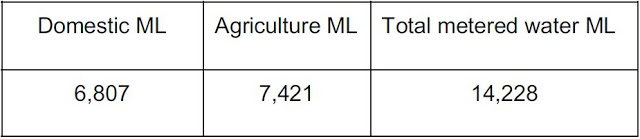
The Table: GVW Water Accounting & and Water Loss illustrates consumption and consumption distribution among GVW customers as summarized in the Table below.


For comparison the table below presents the Predicted consumption figures from Technical Memorandum #1:


The difference between the predicted and actual consumption is quite significant (27,260 ML vs. 14,228 ML or ~92%). The significance of discrepancy shows up in increased infrastructure cost. Part of the high infrastructure cost is due to the oversized infrastructure.

The water loss (unaccounted-for-water) is quite significant. Of the 19,000 + ML inflow only  14,000 ML is metered on the consumer end. That is a loss of almost 5,000 ML or ~35% (as a percentage of the consumed water). The value of this lost water is anywhere from $3.9 million to $12 million depending on what water rate we consider ($0.79/ m3 or $2.37/m3).


Schedule K

A great deal of effort was spent on justifying the low agricultural contribution to revenue. My concern with the agricultural subsidy is that it is spent on treating agricultural water. This has no benefit for agriculture and it is a huge drain on domestic customers' pockets. If we were to provide cash to agriculture in lieu of compensation for water licenses obtained from agriculture it would benefit both parties.

According to the Summary Table the difference between agriculture expenses and revenue is only $63,349. It drastically differs from consultants estimates of between 12 to 18% of annual costs attributed to agriculture.

Schedule L

Debt payments are listed as $2,911,957 (capital of about $41.6 M) whereas the borrowing costs in Schedule K are shown as $2,176,545 (a capital of about $31.1 M).

There is a lot of information provided in the staff report and it is hoped that Directors utilize them properly. A proper distribution of rates would significantly reduce the burden born by domestic customers. It would be a lot fairer distribution of water rates. Domestic customers do not need preferential treatment, they just need fair treatment especially those who use the least amount of water."


"Domestic customers do not need preferential treatment,
 they just need fair treatment
 especially those who use the least amount of water."
                           Gyula Kiss, Coldstream councillor


 "Democracy equates to majority rule," offers Kia, adding "so Gyula Kiss remains a lone voice against the North Okanagan's water insanity."

That's a shame.
Because we certainly have bureaucracy!
In spades.
   

Sunday, June 12, 2016

Two Battles Ended


Gyula Kiss' vehement opposition to the 2012 Master Water Plan--and biases of bureaucrats, consultants and politicians alike--has been unwavering.

At Thursday's Greater Vernon Advisory Committee meeting, Mr. Kiss continued to oppose the "biased" information that had been provided to the Stakeholder Advisory Committee that led to the committee's recommendation to maintain the two existing water sources and the two existing treatment facilities.

As reported by Rolke in today's Morning Star story, Mr. Kiss said the committee did not consider broad-based information. 
No-one would argue that broad-based information had not been provided the committee.

"When it came time to receive the stakeholder report for information, Kiss did not raise his hand as opposed.  Chairperson Cunningham tried to clarify Kiss' vote," said the story, "but did not get a response."

"I guess he's in favour," Cunningham said.

No, he's not.
But he knows his water battle has ended.
And he was--understandably--preoccupied during the meeting.

Because another battle had just ended.
A very personal one.
Mr. Kiss' wife, Debbie Gibson, lost her battle to cancer nine days ago.

So it was only through his incredible commitment to the community--and the water situation--that he even attended the Thursday meeting.

Two battles have ended for Mr. Kiss.

Residents offer sincere sympathy to the Kiss family on their bereavement.

And our considerable thanks for his efforts on the water battle.

Monday, May 16, 2016

The Brilliant Gyula Kiss


...always has been, and always will be.
Yes, he's a brilliant man.
A scientist, unlike many decision-makers and politicians that oversee the Greater Vernon Water debacle (old or ongoing) in the North Okanagan.

But instead of reprinting his May 16th story "Is there scientific evidence for pending water shortages in Greater Vernon in 2016?", I'll just send you to his blog (scroll to the May 16th, 2016 story if it's no longer on the title page).

Click here to access Gyula's blog.

"We shouldn't let anyone but scientists be hired as bureaucrats or to run for political office," offers Kia.


Agreed!

Friday, May 6, 2016

RDNO Challenges Merriam-Webster


...on the definition of consensus.

No matter that Merriam-Webster has been in the dictionary business since 1831.
The Regional District of North Okanagan disputes the learned enterprise's definition of consensus.

Merriam-Webster's definition:  "a general agreement about something : an idea or opinion that is shared by all the people in a group".

All the people in a group.
Not some.
Not most.
All.

You decide.
Here's the Morning Star's story today, by Rolke.

"No changes for water plan"

Greater Vernon's master water plan appears to be largely unchanged.

The Greater Vernon Advisory Committee was told Thursday that a stakeholders' advisory committee (SAC) is recommending Duteau Creek and Kalamalka Lake by maintained as drinking water sources and that two treatment plants remain.

"The majority is satisfied all feasible options have been considered," said Juliette Cunningham, GVAC chairperson who also sits on the SAC.

A bulk of the SAC also agreed that partial separation of agricultural land from treated water should occur.

Jim Garlick, GVAC director and SAC chairperson, supports having two water sources because of the flexibility it provides.

"There is no consensus..."  Terry Mooney, CCMWP

"If there is an emergency or repairs that need to be done, we can take care of that more easily," he said.

Terry Mooney, a SAC member, is blasting the actions of most of his colleagues.  "The majority wanted to rubber stamp what the consultant recommended," he aid, adding that he wasn't the only member opposed to a string of recommendations April 21.  "All of our objections were shot down.  There is no consensus."

"So any input from an opposing view was eliminated."  Gyula Kiss

Mooney insists total separation of agricultural land from treated water should occur.

"Duteau should be strictly for irrigation.  All domestic water should come from the Mission Hill treatment plant (Kal Lake) and eventually Okanagan Lake," he said.

Gyula Kiss, a Coldstream councillor, isn't surprised with the process' outcome.

"They wouldn't allow me to get on to the committee and then they eliminated me from GVAC," he said.
"So any input from an opposing view was eliminated."

Garlick says all information was provided to the SAC and the group was not forced to maintain the status quo with the master water plan.

"They didn't allow themselves to be pushed around.  They chose their own path," he said.

A 2014 referendum to borrow $70 million for the water plan was shot down by residents, and Garlick isn't sure what would be borrowed now.

"We have reserves and there could be other money to tighten it up," he said.

The stakeholders advisory committee will meet May 19th to discuss its final report, which will then go to GVAC for consideration."  Morning Star newspaper


"So Garlick admitted there was 'pushing around' when he stated that SAC didn't allow themselves to be pushed around...not for lack of trying" adds Kia.

Interestingly, in the same newspaper today there's a quotation in a letter to the editor (on an unrelated topic) that appears to sum up GVAC's and RDNO's year-long strategy of how they dealt with not only Gyula Kiss, but Citizens for Changes to the Master Water Plan's Terry Mooney:

"Before the opening of hostilities enlist the support of the masses
by first demonizing the enemy."


Of course there's a conflict of interest...the politicians that support the status quo were the politicians that approved it in the first place!  A face-saving strategy.

Aided and abetted by consultants and the media...


The outcome of the Master Water Plan's "review" wasn't unexpected.

The interesting thing is that there'll likely be another water borrowing referendum.
Perhaps the public's "consensus" will again be more pronounced than at SAC meetings.

Politicians should look up how Merriam-Webster defines the phrase municipal elections.


Friday, February 26, 2016

Penpals?


A recent letter to the editor has prompted a terse reply from Coldstream's Gyula Kiss, who sets the record straight!

The above letter was published in the Morning Star on February 21, 2016. The following is my response to that letter.

"Nice to see that someone appreciates my efforts of trying to make sense of the MWP! Unfortunately, I cannot take all the credit for the defeat of the referendum last November. The writer may remember that there were two members of GVAC who voted against both the MWP and taking it to referendum. The rest of the GVAC members supported the plan and sent it to public scrutiny. Staff and consultants put forward their best efforts to convince the public to vote “yes”.

During the election campaign something changed. Most of the candidates running for office declared that they no longer supported the referendum and they would vote against it. Why did these candidates change their minds? Did they receive additional information on the plan? If they could share this new information with the members of SAC it would make their work a lot easier." 

The only two sitting Directors on GVAC who remained supporters of the referendum were those who were acclaimed without having to campaign. Oddly, those are the only two Directors who are NOT customers of the GVWU and do not pay for the MWP.

You mention using cash-basis to cover the costs of the MWP budget. That is exactly what staff had been doing since the 2004 referendum. Ratepayers approved the borrowing of $35 M for the MWP yet we spent over $66 M by 2012. Where did the extra cash come from? It came from direct cash extraction from ratepayers. This was against the spirit of the referendum as this cash is not shared by future ratepayers. If staff needed $66 M they should have asked for a loan approval of $66 M not $35 M.

The DCWTP was not recommended by the Consultants of MWP 2002. In fact, they declared the current plan a waste of money. Which consultants were right? Judging from the results the 2002 consultants were right.

Adding a filtration plant to Duteau was not mentioned in the 2004 MWP Addendum. That was kept a secret for fear of rejection of such large referendum bill.

The cost of borrowing $35 M is about $2.4 M annually. This represents about 12% of the total budget of $19.6 M. Feet dragging is not the cause of the high bills: the cause is the high cost of operation and maintenance of the triple  water system. We now operate the Kalamalka Lake system, the old VID system with the domestic quality irrigation water and the new raw water irrigation system built by the ratepayers of GVWU. Those are the sources of the high water cost. Ad to this the cost of the two filtration plants in the plans along with their operation costs and you’ll see where we are heading with water rates.

One would hope these high water costs are shared equally by all customers. Not a chance! The majority of RDNO Directors just approved the rates for 2016. Domestic customers will continue to subsidize ICI customers for over $2.5 M for 2016. If subsidies are necessary than the entire community should contribute through a RDNO Function. As it is only domestic water customers participate in this subsidy. The two Directors who fought hard for this subsidy are not participating in the costs. Easy to tell others to pay if you do not have to do the paying yourself!

So these are just some of the facts. There are lot more but let’s leave those for another occasion.

Writing a letter to the editor is easy. Writing a factual letter is a whole lot more difficult.
Some of you may wonder how the $2.5 M subsidy above was arrived at. Here is a quick summary:

Budget requirement for 2016:     $19,600,000
Agriculture contribution:              $     783,799
Needed from domestic:              $18,712,520
Expected water sales:                   5,820,000 m3
Cost of 1 m3 of water:                  $3.22
Water consumption ICI                   1,580,000 m3
Expected revenue    @ $3.22      $  5,080,000
Subsidized revenue @ $1.58       $  2,496,400
Difference (subsidy)                 $  2,583,631

These are real, hard figures calculated from the data provided by staff. We can manipulated anyway we wish but the real facts are these. Anyone who gets his/her water for less than $3.22 per m3 is being subsidized. The base fee of $408/a in real term is the value of 126.71 m3 of water. In other words we pay for 126.71 m3 of water without getting a drop.

Only (residential) water customers are forced to subsidize ICI customers.

The annual repayment of borrowing costs us 898,470 cubic meters of water. Every item in the budget can be expressed in terms of unit cost of water ($3.22 per m3). Employees' wages: every $10,000 costs 3,106 m3. Thus, if we subsidize anyone we force the rest of the customers to pay more than their fair share of those costs.

Mr. Kiss is absolutely correct!  
Kia offers a suggestion for letter writers:


Saturday, December 12, 2015

2016 Water Rates Proposal


You'll be able to plunk in YOUR numbers.

A sure sign that something interesting was before them on Thursday was bureaucrats' eyebrows arching.
Even politicians who normally pooh-pooh Gyula Kiss' proposals seemed interested.

He's done it again.

Gyula Kiss has proposed a 2016 Water Rates proposal that has everyone paying the same rate.
Before you freak at the $2.59 / m3 rate because, as a homeowner, you're currently paying less per cubic meter with your family's conservation efforts...pay attention.

Your water bill will likely decrease!

Dig out your water invoices.
Calculations will be done for you.

As Bob Spiers' blog states:
  "Councillor Kiss' rate structure is basically to lower the base fee to $55.59 per quarter ($25.86 base + 29.73 for borrowing outstanding) and charge everything above the first 10m3 per quarter at the rate of 2.59m3. Everyone in the non agriculture class would be charged the same base fee per connection and the same consumption rate. (Residential, Commercial, & Institutional)

How this would affect the various classes can be ascertained by using the online calculators . Just click in your average quarterly consumption (in the yellow box) to see the effect on your water bill when compared to the 2015 rates. Note there are separate calculators for residential and Commercial/institutional.

Remember that this is an alternate rate structure proposal that will be discussed at the rates workshop that will be held in January or February of 2016."


Dig out your water invoices.

The residential calculator is here:
https://docs.google.com/spreadsheets/d/1HMfaBLo5llptiYVNIxMhGKhVVHpPcPXKcpav5Ecvn7k/edit#gid=0

The commercial/institutional calculator is here:
https://docs.google.com/spreadsheets/d/1FgwH8iYm8oRsvp2KsIs70yG4ipyhy1RYHu-a08mgzT8/edit#gid=0


 "The advent of fairness?" asks Kia.

Now let's see if GVAC can achieve consensus in their rates deliberations...coming up early in the New Year.

Resource:  Water Rates Bylaw 2672, 2015, beginning on page 9. 


Saturday, November 28, 2015

Nine Memoranda Shroud the Truth


Were 9 memoranda produced to hide the truth?

We do know that GVW staff manipulated water consumption and other information that led to the 2012 Master Water Plan, all the while strong-arming water consultants (who averaged between 5 and 7 revisions to each client memoranda), until text and statistical tables satisfied GVW engineers).


Yes, the memoranda hide the truth.

Residents' abhorrence to irrigating farms with chlorinated water from Duteau Creek Water Treatment Plant (DCWTP) resulted in their soundly rejecting the borrowing referendum last November.

the solution is...to no longer throw good money
after bad.
  Chlorinated water will no longer irrigate farms and orchards.  Undiverted and undammed streams and creeks will flow as they were destined--to Kalamalka and Okanagan Lakes--
ensuring fish habitat.
Today's residents will not pay for future infrastructure.
             As population increases, new residents must pay
               their fair share via Development Cost Charges.  

Since then, Greater Vernon Water engineers--and the politicians they've misled--circled the wagons and spurned an independent professional MWP review.  Greater Vernon Water engineers and colluding politicians instead chose to appoint 18 laypeople to a Stakeholders Advisory Committee to conduct the review.  GVW engineers handed each appointee a tome of ~1,000 pages, and then "guided" each review segment, overseen by Committee chair Jim Garlick and GVAC chair Juliette Cunningham.

Do Cunningham and Garlick have vested interests in seeing the MWP proceed unchanged?
Sure they do.
They're two of a contingent of eight elected officials, the majority of whom approved the current Master Water Plan.

Back to the truth.

The tireless champion of truth is Gyula Kiss, whose membership on SAC was denied by the manipulators--GVW engineers--because he was deemed to be "biased".
So GVW are conducting a fixed horse race.

"By making the adjustments I recommend,
 Kalamalka Lake—with the transfer of upland licenses—
could supply domestic water well past 2052!"  G.Kiss

Gyula Kiss' analytical brain has found the solution to the Master Water Plan dilemma.  The public will support the solution because it no longer throws good money after bad.  Chlorinated water will no longer irrigate farms and orchards.  Unamended streams and creeks will flow as they were destined to flow--to Kalamalka and Okanagan Lakes--ensuring sufficient water for fish habitat.  Current residents will not bear the brunt of the area's future water costs. 

Grab a coffee, and learn the truth from the expert, Gyula Kiss:


"Re:  Greater Vernon Master Water Plan 2012


This plan does not produce the desired outcome of a cost effective solution of Greater Vernon’s water problems. Instead of maintaining the low cost agricultural water system the early settlers of the valley built and providing a cost effective separate domestic system, we maintain a significant, expensive mixed system that created the problems in the first place.


I would like to offer some alternate solutions which could reduce the immediate financial burden on the taxpayers and improve the chances of a positive outcome of an infrastructure financing referendum.


Technical Memorandum #5 states:


“Agriculture is an important industry in Greater Vernon whose on-going economic viability relies on access to an adequate supply of low-cost water. Currently, the Greater Vernon Water Utility (GVW) services domestic and agriculture users with treated water from the Mission Hill and Duteau Creek Water Treatment Plants. Most agricultural practices, however, do not require treated water; particularly irrigation or stock watering. The current agricultural demand averages (180 ML/d), significantly higher than the peak day demand for domestic use of 57 ML/d. A strategy within the 2012 Water Master Plan will be to implement capital projects that, in the long term, reduce use of potable water for agriculture, while maintaining a robust, reliable and cost-effective supply/distribution system.”


The following statement was provided in the 2004 Addendum to the Master Water Plan:


Separation of the existing combined water system will provide the most cost effective water management in the long term. Portions of the existing water distribution system serve both domestic and agricultural irrigation customers (termed the “combined system”). On an annual basis, approximately 80% of this water is used for irrigation of agricultural land. With the increasing requirement for drinking water treatment, it does not make economic sense to treat the water going to irrigation. Separation of the existing combined system into separate domestic water and irrigation water systems will allow the appropriate water quality to be applied to the end use.


The newest version of the Greater Vernon Water Master Plan was summarized to the Stakeholders’ Advisory Committee, with plan objectives as follows: 


“Supplying domestic water quality to the domestic customers within the GVW service area is the primary issue driving the development of a regional water supply scheme review. Interior Health has stated that treatment improvements and a plan to finance the necessary capital investments need to be completed. The development of optional regional water supply schemes that result in the supply of Interior Health compliant drinking water to the existing customers is a critical outcome of this study.


As the appointed political representative on the Greater Vernon Water Technical Advisory Committee, I had an opportunity to assess the proceeding from a perspective that differed from that of consultants and staff.


One of my observations was that the existence of the $29 million Duteau Creek Water Treatment Plant (DCWTP) biased the decision-making process of the consultants and staff.


The other issue was the fact that significant funds were expended on trying to make the plant work.


The current plant at 162 ML/day was not large enough to satisfy maximum daily demands;other changes had to be made to the irrigation system at significant costs. The majority of the $68 million spent to date was spent on the DCWTP and altering the irrigation system.

Having made these huge investments it is understandable that there was a major effort to concentrate on solutions that would include the existing DCWTP in the final MWP 2013.


In spite of these efforts there is no denying that roughly $10 million was wasted on the oversized plant (the current plant was designed to produce 162 ML/d; the new plan calls for a plant size of 110 ML/d). 

Suggestions to investigate other options were not welcomed. Instead of considering ways of making alternate solutions work, there were arguments made why it would not work. As an example: when it was suggested that we could expand domestic water supply to the entire Greater Vernon Water system from the Mission Hill Water Treatment Plant (MHWTP), the first argument was that we did not have enough water licenses on Kalamalka Lake.

When it was pointed out that licenses from Coldstream Creek and Deer Creek totaling over 4,000 ML could be transferred to Kalamalka Lake, the response was that it would be very difficult if not impossible to achieve the transfer.

However, when the consultants proposed to transfer licenses from BX Creek to Okanagan Lake so we could pump clean Okanagan Lake water to Goose Lake for irrigation purposes the comment was that the transfer would be no problem.

The recommended solution of the 2002 MWP was to create an independent, stand-alone domestic system.
The 2013 plan will not do that.

"...Duteau is primarily for cheap water supply for agricultural purposes."  

One of the ramifications of maintaining the mixed system was demonstrated earlier this year. High turbidity at Duteau Creek rendered that treatment plant unusable. Thus, treated water had to be dispensed from the MHWTP through the existing co-mingled pipe. The irrigation system had to be shut down to allow this pipe to be used for domestic water distribution.

If total separation was done the two systems could have operated independently without interruption.

This kind of event could happen in the peak irrigation period with serious consequences.  The Duteau Creek water supply is treated as if it were free to use however the consultants pleased.

We must remember that the Duteau supply is primarily for cheap water supply for agricultural purposes.  There is no agricultural land in the North Okanagan without affordable irrigation water. All lands classified agriculture land should have the right to receive low cost water. Otherwise they should have the right to apply for removal from that classification.

"GVW's...proposed 2013 plan will cost about double 
what the first consultant group estimated for total separation
 yet the original problem will remain.
 Most of the filtered water produced by the new plant
 would still end up on agricultural crops."

According to the consultants of 2002 the major problem with the old Vernon Irrigation District model of delivering domestic water was that they did it through the irrigation system. Treating all the water regardless of use would be extremely impractical and very expensive. The recommended logical solution was total separation.

That recommendation was ignored in 2004 and the consequences are today apparent in cost and delivery problems.

The proposed 2013 plan will cost about double of what the first consultant group estimated for total separation yet the original problem will remain. Most of the filtered water produced by the new plant would still end up on agricultural crops.

There were hundreds of pages of reports produced with charts, tables, graphs, etc. with little chance that politicians would be reading—let alone understanding—them.

Indeed, some assumptions were illogical and appeared to be padded to support the recommendations.  For example, the domestic water demand forecast table, on which the whole plan is built, started with the 2011 forecast at 9,670 ML/a culminating in 2052 at 13,360 ML/a.
In reality the actual 2011 consumption reported by GVW was 6,359 ML/a and 5,720 in 2012.
By making the adjustments I recommend, Kalamalka Lake—with the transfer of licenses—could supply domestic water well past 2052!

Huge effort was expended on ways to enlarge the Duteau reservoir capacity to increase our water supply.  Yet the potential of Okanagan Lake was totally ignored with the comment that we do not have enough licenses on Okanagan Lake. 

As a matter of fact, the total volume of the licenses we hold on Coldstream Creek/Deer Creek, BX Creek, Kalamalka and Okanagan Lakes exceeds 23,500 ML/y.

If all these licenses were transferred to Okanagan Lake—into which all these sources flow—we would have sufficient water supply for 80-100 years.

These options should have been investigated at the outset as Okanagan Lake water would be cheapest domestic source without interfering with the perfectly functional irrigation system.

In addition, there would be environmental benefits (e.g. fish spawning) from allowing the tributaries to complete their flow to Okanagan Lake.

"...instead of financing various projects for the agricultural separation ...  charged cash on top of the finance charges for the $35 million borrowed.

   It would be totally unfair
to domestic customers to continue with the practice."

"Current customers never recover the funds they expended." 

The huge treatment costs at the DCWTP are basically recovered from domestic customers. In 2011 the total treatment cost at the plant was over $1.7 million. Billed domestic consumption was about 1,500 ML.  Thus, the cost per cubic meter for domestic consumption was around $1.13. That does not include the amortization cost of the borrowed $29 million ($2 million plus).

At the same time treatment costs at the MHWTP amounted to $625,577 and the billed consumption was 5,000 ML. Cost per cubic meter: $0.13, a significant difference.

In the 2013 plan actual treatment costs are not quantified. Financial information is limited and mainly deals with estimated costs of various projects.   When one compares the estimated costs of the 2004 Amendment with reality ($35 million estimates, $68 million spent) one must be excused for having doubts about the accuracy of these estimates.

There is no reference to how the plan is financed. Water customers have been heavily charged in the last few years for water quality they have not received. The main reason for this burden was the fact that instead of financing various projects for the agricultural separation they were charged cash on top of the finance charges for the $35 million borrowed. It would be totally unfair to domestic customers to continue with the practice.

Currently the annual budget of GVW includes $8 million for Master Water projects. We cannot carry out any plan based on an annual $8 million charge. It is obvious that the plan must be financed over 20 years and must be completed as soon as possible so customers can reap the benefit of their investment while they are still alive.

Fifty-year life cycle analyses were carried out which are of little consequence for current customers. Financing infrastructure is based on a 20-year loan. Once the loan is repaid those costs disappear and only operation and maintenance costs carry on. Current customers never recover the funds they expended.


Another financial error is that all costs are assigned to the current customer base. No mention of how development cost charges will affect cash flow in the future.

The need for additional water supply is necessitated by growth. Developing these additional supplies should be covered by Development Cost Charge funds.  Supplementing water supply once the Kalamalka license is fully utilized should be paid for by DCC’s and should be supplied from Okanagan Lake (OL).

One of the curious proposals is to pump OL water to fill Goose Lake (GL), ostensibly to reduce costs.

Filling GL from DCWTP costs between $129,000 to $270,00 annually. The proposed cost of filling GL from OL would require a pump station at OL for $2.6 million (amortization over 20 years would be $180,000 per year) and $160,000 pumping cost annually for an annual total of $340,000.
This is between 1.25 and 2.63 times more than filling Goose Lake from Duteau Creek Water Treatment Plant. 

click table to enlarge
MWP 2013 proposes to have a filtration plant built at DC with a capacity of 110 ML/d in 2017. The overwhelming majority of treated water would be produced during the 92 days of peak demands at which time likely 90% of the water would be used for irrigation.

Thus, we would have filtered water for agricultural crops while the 80% of customers using MHWTP water would not receive filtration until 2022.

There is something wrong with this picture if the main aim of Interior Health's requirement is to provide highly-treated water for domestic customers.
 
A better alternative to this plan would be to dedicate the DC water supply to irrigation as it was intended at the outset. It cannot be overstated that affordable water is paramount to our agriculture industry. 

"We currently budget $8 million annually
for MWP projects.
That could finance a loan of up to $114 million. 
Treatment cost savings from DCWTP could finance
 an additional $20 million"

The current DCWTP should be gradually removed from operation as the domestic system expands. Untreated water should be provided to all agriculture classified lands with allocation and allocation fees.

Domestic water supply should be obtained from the Okanagan Basin water sources (Okanagan Lake, Kalamalka Lake, Coldstream Creek/Deer Creek and BX Creek) by way of license transfers.

It appears that the most affordable plan would be the utilization of Option 7 - Complete System Separation - Centralized Treatment at Mission Hill - Additional Flow from Kalamalka Lake (license transfers). Proposed revisions to Consultants’ plans are shown in Table 1 and Table 2 below.

For the plan to work, we would need license transfer to Kalamalka Lake from Coldstream and Deer Creeks, both of which are natural tributaries to Kalamalka Lake.  We anticipate this plan could achiever filtration deferral until 2042.

Estimated capital costs to 2042 would be $98.1 million. If needed, a filtration plant could be built in 2034 using DCC’s and debt financing.  By then earlier debts would have been retired.

Once capital cost debts are retired, significant cost savings occur.
For example, the 2011 treatment costs are compared at the two treatment plants:  In 2011, treatment costs at Duteau Creek Water Treatment Plant were $1.7 million and 1.7 ML was used by domestic customers (about $0.99 per cubic meter).
At the same time, treatment costs at the Mission Hill Water Treatment Plant were $625,577 and billed volume was 4.6 ML ($0.13 per cubic meter).

If all of the domestic water was treated at Mission Hill, the savings in treatment costs would have amounted to $1.5 million.

Trihalomethane levels from Duteau Creek Water Treatment Plant
 are up to four times higher than those at the Mission Hill plant.


Furthermore, the MHWTP water ultraviolet treatment and chlorination produces an additional benefit with a significantly lower Trihalomethane (THM) content (40-50 ug/l), while the treatment at DCWTP was only DAF treatment and chlorination, where the THM content was 100-200 ug/l.


How would we finance the plan?

We currently budget $8 million annually for MWP projects.

That could finance a loan of up to $114 million.

Treatment cost savings from DCWTP could finance an additional $20 million if needed.


The benefit of this system would be huge and total separation would be achieved.


The 2002 MWP was reviewed by a peer group. It would be wise to have the proposal reviewed by another independent professional review group to ensure that we are getting the best plan for our money.


It appears that financing would require that we must seek assent from the taxpayers to borrow the needed funds.


The promise of total separation of the domestic system from the agriculture system would greatly increase taxpayers’ support."


                                                           compliments of  G. Kiss

                                                           Councillor, District of Coldstream

                                                           Greater Vernon Advisory Committee
   
Tables (click to enlarge) follow:


(ignore incorrect reference to Option 4 Capital Costs)


(ignore incorrect reference to Option 4 Capital Costs)


Addendum:
The following are what SAC members will consider at their Dec. 3 meeting:


Note:  the yellow highlighted area, referring to the 2014 winter residential demand at 286 L/ca/d and the July per capita demand at 1,779 L/ca/d. If we use 31 days in July and 55,000 users the total consumption would be 3,033 ML just for that one month. Let's say we would be using only 286 L/ca/d for the rest of the year (a very charitable assumption) it would amount to an additional 5,253 ML for the rest of the summer months the total sum of the consumption would be 8,286 ML for the year. While GVW admits they had some troubles with their software that would be a significantly higher consumption than what was published in their 2014 Annual Report (5,819 ML).

Click table to enlarge


The following table shows the actual consumption in Coldstream for the years 2013, 2014 and 2015 partial.  Using a conservative population figure of 10,000, G. Kiss estimated the quarterly water demand for all of the quarters as presented (consumption/91.25/10,000*1,000). Note the 3rd quarter per capita at 599 L/d.

click table to enlarge
If you used the average daily consumption value in the Coldstream data at 300 L/d and multiplied it by 55,000 (GVW population) x 365 you will get an annual consumption of 6,022 ML, somewhat closer to reality. 

And SAC will consider Water Conservation:

Click table to enlarge

Resources:
1.  Some comments regarding the Regional Water Authority, 1991.  G. Kiss
2.  Greater Vernon Master Water Plan 2002
3.  Addendum to the Greater Vernon Master Water Plan 2004
4.  TM#9 System Separation Option Analysis 2013.
5.  Greater Vernon Water Annual Report 2011.
6.  Greater Vernon Water Annual Report 2012.

7.  Mike Stamhuis' letter in 2013, comparing Options.
The most important segment of Stamhuis' letter is this:  "For example, full separation would permit the option of a separate sub-regionally governed agricultural distribution utility which would have a substantial rate impact on the different jurisdictions in a devolved utility.  Independent of devolution, a separated distribution system provides many administrative benefits in that it simplifies decision making around farm classifications, sale of non-potable water, new allocations, and use designation.  In addition, there could be economic benefits with expanded use of non-potable water."

8. This from Trafford Hall, head of RDNO in 2012: 


"The public will realize that $98 million will solve all the Water Plan's problems," says Kia, adding "which $70 million would not have done...current domestic customers would've paid, virtually forever."

Separating agriculture water from potable for domestic customers should've been the plan all along.


Greater Vernon domestic customers find themselves in an ongoing mess, with no thanks to GVW engineers.
A huge thanks to Gyula Kiss.

We should've listened to him back in 1991.