Every now and then something on the internet is worth reprinting.
This is one of those, albeit anonymous:
I am Canadian
I am in the minority in Calgary, Vancouver, Toronto and every casino in this country.
I was born in the forties, fifties or sixties, yet I am somehow responsible for some First Nations people being screwed out of their land in the 1700s.
I pay import tax on cars made in Ontario.
I am allowed to skydive and smoke, but not allowed to drive without a seat belt.
All the money I make until mid-July must go to paying taxes.
I live and work among people who believe Americans are ignorant.
These same people cannot name their own country's new territory.
Although I am sometimes forced to live on hamburgers and don't have a pot to piss in, I sleep well knowing that my taxes helped purchase a nice six-figure home in Vancouver for some unskilled refugee.
Although they are unpatriotic and constantly try to separate...Quebec still provides most of my nation's prime ministers.
95% of my nation's international conflicts are over fish.
I'm supposed to call black people African Canadians, although I'm sure none of them have ever been to Africa for that matter.
I am being told that paying a 200% tax on alcohol is fair.
I am also being told that the same tax on gasoline is also fair.
Even if I have no idea what happened to that old rifle my Grandfather gave me when I was 14, I will be considered a criminal if I don't register it.
I am being told that spending $15 billion to promote the French language in the rest of Canada is fair when the province of Quebec doesn't support or even recognize the ENGLISH language.
I am being told that paying $1 million for 3 Stripes ("The Voice of Fire" painting in Ottawa) by the National Art Gallery was a good purchase, even though 99% of this country didn't want it or will ever see it.
When I look at my pension and realize that I take home a third of what I actually make, I say "oh well, at least we have better health care than the USA."
I must bail out big corporations who drive their business into the ground and say, "yeah, that's OK."
And when they move all their manufacturing plants and jobs to a third world country and say "no problem."
I must fork over my portion of the 11.5 million dollars to show the Queen of England and her family a good time visiting in my country even though I can't afford to visit the province next to me.
Canada is the highest taxed nation in North America, the biggest Military buffer for the United States, and the number one destination for fleeing terrorists.
The Lord's prayer is not allowed in our schools anymore because of other religions who chose to move here.
I am an angry white person.
I am one pissed off taxpayer who is broke.
"I'm Canadian too," suggests Kia.
Thursday, May 30, 2013


Monday, May 27, 2013
Turbine Operational Again...
At least we think it is.
First a brutal rainstorm while the guys were installing the new micro switch which--by the way--is certainly of better construction than the one that came with the wind turbine 3.5 years ago.
Then, no wind!
Time will tell if everything works well.
"Steel is better than cast", offers Kia.
Hope somebody tells Yangzhou-Shenzou Company!
Oh yeah, the weather! A few shots from today:


Brutal weather!
It's almost June, but you wouldn't know it from the chilly air.
First a brutal rainstorm while the guys were installing the new micro switch which--by the way--is certainly of better construction than the one that came with the wind turbine 3.5 years ago.
 |
| At left is the original and failed microswitch (which reads "turns" of the head rotation) from Yangzhou-Shenzou Wind-Driven Generator Co. Ltd. To the right is the OMRON replacement (purchased from Digi-Key Corporation in Minnesota). The OMRON microswitch is more solidly constructed and has a better cover. |
 |
| The original microswitch (at left) is rusted from a poorly sealed cover; the new one at right is more solidly constructed with a better cover. |
 |
| The better product, from OMRON, a huge Japanese corporation. |
 |
| The original cast mounting bracket on the yawing motor, whose two feet broke. |
 | |
| The new -- SOLID STEEL -- mounting bracket machined by Aberdeen Machine of Vernon BC. | Great job! |
Time will tell if everything works well.
"Steel is better than cast", offers Kia.
Hope somebody tells Yangzhou-Shenzou Company!
Oh yeah, the weather! A few shots from today:


Brutal weather!
It's almost June, but you wouldn't know it from the chilly air.
Sunday, May 19, 2013
Public Comments from Official Community Plan review
Officials say it's been 7 years since the last OCP review of the 25 year old plan.
So they held Open Houses May 6th and 8th to gauge what the public wants to see in the years to come as the District of Coldstream moves forward.
Dispensing with the normal preamble--residents state they've heard it all before, numerous times--public comments during the open house are listed here.
Some for amusement, some for concern, some for outright disdain.
You be the judge:
Parks and Trails:
- Would like to see the Grey Canal Trail expanded out through Coldstream;
- Open up right-of-way access points to Kalamalka Lake; allow parking and parks for disabled persons;
- Open up access to the foreshore of Kalamalka Lake;
- Imagine an inter-municipal trail system from Lumby to Vernon to Oyama and north to Armstrong/Enderby, maybe along the railway;
- Establish a trail around Middleton Mountain at one elevation.
- The walking path next to Kalamalka Road is too narrow and dangerous (needs barrier or a proper trail).
- Trail needed on Kidston Road from Torrent Drive to Kalamalka Road (steep bank is difficult and dangerous);
- Pathway down from Michael Drive should have steps (gravel surface and slope is dangerous).
- Bike path needed along Kalamalka Road from Alpine Centre to the lake;
- User friendly commuter trail system linking Lavington to Coldstream and Vernon (should be off the highway) to promote health and a greener community;
- More biking and walking paths in Lavington and bike trail into Vernon;
- Safe bike paths to connect to the school in Lavington (easements through Tolko and the glass plant site);
- Acquire rights-of-way to establish the Grey Canal Trail from Coldstream Ranch east and west;
- Lakefront should be protected and made into a public trail;
- Trail needed from Kalamalka Lake to Polson Park;
- Need a better or improved boat launch;
- Overpass to access Kalamalka Beach;
- Bigger and better boat launch (one that can better accommodate tourists);
- Ban power boats on the north end of Kalamalka Lake;
- Proper bike paths away from traffic lanes;
- Bike and walkways llinking all of Kalamalka Road;
- Existing rural parks be maintained;
- Trails need to be connected so they make sense;
- Trail connecting Lavington and Coldstream (using public easements)
- Part of glass plant property should be made into a park;
- Bike lanes for children is a priority for Learmouth;
- More green corridors; grass half of Kalamalka Lake Park;
- Ban power boats or power restrictions on north half of Kalamalka Lake;
- Road ends to lakeshore should be set back to public access.
- Secondary suites that are reasonable should be allowed;
- Secondary suites need to move into 21st Century, not everyone can afford a house but with standards and controls and following best practices;
- There are already a number of suites, they increase noise and parking problems;
- No secondary sites without parking; no suites in houses on septic service;
- Secondary suites should not be allowed especially if it means on-street parking;
- Secondary suites are good with proper regulations and some flexibility;
- Secondary suites must only be in owner-occupied homes with adequate parking;
- Allow secondary suites in R1 and R2 neighbourhoods (2);
- Secondary suites provide security for snowbirds going south for the winter;
- Yes, allow carriage houses in Lavington (especially on lots over one acre);
- Develop downtown area for high-end condos;
- Develop hillsides for condo developments;
- Need areas of Coldstream for high end gated villas and condos;
- Develop hillsides with high density housing;
- Definitely no small lot designs;
- Limit urban growth to Middleton Mountain and Coldstream Estates;
- Residential planning should consistently follow the same rules (i.e. setbacks);
- New housing should identify the proposed demographic (seniors or families);
- Infill existing areas before expanding to new ones (urban containment boundary);
- Higher density housing near town centre.
- Not in favour of home plate regulations;
- Concerned about pesticide use and particularly how it affects our creeks;
- Concerned about noise from the new cherry orchard; understood that they are running a business but there has to be respect for the community too;
- Recognize the difference between viable and non-viable agricultural land;
- Backyard chickens should be allowed (no roosters);
- Set strict agriculture boundaries with no urban growth;
- Support farmers and community gardens and farmers' markets;
- Municipality needs to sponsor controls for geese and deer pests;
- Do not use chlorinated water for irrigation (we need separation);
- Support ALR landowners so they can produce local products;
- Ensure low cost irrigation water to insure the viability of agriculture land (2).
- Focus on land surrounding Kalamalka Lake Park; a plan with Vision (incl. parking);
- No need for a Town Centre; just a means to stay separate from Vernon which is not sensible;
- Don't need commercial on the highway (park and mix of housing instead);
- No town centre plan; not sustainable and will undermine Vernon businesses;
- Small scale commercial at Kalamalka Lake could be supported by visitors with beach front opportunities;
- Change the glass plant property into an industrial park;
- Support town centre with a mix of commercial and residential zoning;
- Only light industrial uses on the glass plant property;
- Maximum use of the railway; railways needs to be reliable;
- Mixed use in town centre;
- We need a community hall in Lavington;
- A community hall is needed in Coldstream for community interest and trust;
- Heritage preservation of Husband property;
- Promotion of heritage spaces (i.e. Sovereign House, Ormsby House) and a Heritage Council;
- Lack of social infrastructure for events and foster community spirit;
- Need a community hall for Coldstream that is central, modern and affordable;
- We need heritage promotion and preservation;
- There is a need for a community hall in Coldstream;
- Coldstream museum at Sovereign House;
- Protection for heritage houses and trees;
- Heritage preservation of Husband property;
- Promotion of heritage spaces (i.e. Sovereign House, Ormsby House) and a Heritage Council;
- Don't extend sewer until existing serviced lots are connected, especially lots near creeks;
- Sarsons Road is dangerous for walking;
- Improvements needed at the intersection of Kalamalka and Kidston Roads;
- No sidewalks; paved lanes are fine;
- Better pathway along Kalamalka Road (people are taking risks);
- Husband Road should not be a collector road;
- There should be non-treated water on agricultural land;
- Extend sewer line up Aberdeen Road;
- Extend sewer line on Giles Road;
- Put bike lanes and pathways only in strategic areas and spend more money making these few safer (i.e. offset from roadway);
- Put sidewalks and bike lanes on all roadways.
You're not the only one, as I recall Winston Churchill's oft-repeated quote:
"Socialism is a philosophy of failure, the creed of ignorance, and the gospel of envy, its inherent virtue is the equal sharing of misery."...nuff said.
Saturday, May 18, 2013
Wind Turbine Repair
It was a Sunday (end April/early May) and the wind was howling.
Golfers said the 107-yard water hole was playing 145 yards.
And they said the wind turbine's rotors were "really flying, like a helicopter".
Well, all hell broke loose during a rogue gust before the turbine's controls could move it out of the wind.
Immediately, the 10kW wind turbine stopped responding to wind direction.
Something was obviously wrong.
Probably seriously wrong.
So last week, Paul Wende and Hugh Cameron lowered the tower via its hydraulic arm and opened the nacelle.
 | |||
| Hugh (at left) and Paul lowered the turbine and opened the nacelle for the inspection. |
A cast mounting bracket for the yawing motor had several broken "feet" (one having perhaps failed some time ago). With the loss of a second foot during this storm event, the bracket could no longer hold the top bearing of the yaw shaft and the mounting bracket failed entirely.
 |
| Paul Wende discovers what part has failed. |
 | ||
| The two broken "feet" of the mounting bracket for the yawing motor are easily seen (above photo) at bottom left of the exposed orange painted cast part (where the broken two feet failed and were shorn away from the orange-painted bracket.) The parts were found--and removed--from inside the nacelle. |
 |
| Pointing the camera inside, standing on my toes, everything else looks fine, says Paul Wende. |
Then it's fingers crossed that was the only item to fail during the storm!
"Golfers have been asking if the turbine fell down," grins Kia.
Thank goodness the answer to that is NO.
Friday, May 10, 2013
The Rhetoric of the Uninformed
But it gets press.
As did this Black Press story by Judi Steeves entitled "Automated watering systems spur debate".
As an engineer who graduated with distinction you would think that Tom Siddon, longtime politician and current director with the Regional District of Okanagan Similkameen--and founding chair of the Okanagan Water Stewardship Council--would know what other local engineers know.
But that's not a given, obviously.
He recently spoke at the Okanagan Basin Water Board meeting where discussion centered on modern automatic irrigation systems.
"I suspect automated systems are wasting water by coming on whether they're needed or not."
Tom Siddon, Area "D" Director
Anna Warwick Sears, OBWB executive director explained there are now "smart" irrigation systems as well as "stupid" ones.
 |
| The Hunter I-Core, one of three "smart" irrigation controllers at Highlands Golf in Coldstream, BC |
Another director, Gerry Zimmermann said he was under the impression that automated systems saved water.
OBWB Chair Stu Wells added "most systems are set to run for the same length of time in April as in July, and that most people don't know how to operate their systems, never changing the settings.
(Sheesh...wonder who participated in that poll!)
The uninformed leading the misinformed.
And it gets even better.
Mr. Zimmermann then offered: "Most people also don't turn off their systems during rainy periods when irrigation is not needed."
At this point, engineer Tom Siddon--distinguished engineer Tom Siddon--should have relied on his education to inform the uninformed.
So I'll now back up to a different meeting six years ago and quote what another engineer told me--when he agreed with my comment at a water meeting of commercial water users: "On my golf course--with its southslope and exposure to wind--I turn the irrigation system on half an hour after rain has started, and I use less metered water that way!"
The engineer beside me nodded in agreement.
Others at the table looked puzzled, so the engineer added (on my behalf, because I'm not an engineer), "your south aspect, rocky substrate and high winds--when combined with the light dark soils of that area--actually evaporate irrigation water when applied to the dry and hot landscape. Rainfall--besides being free from the sky--softens the soil and acts as a wetting agent to better accept the metered irrigation water she then applies with the irrigation system. Rainfall allows the irrigation water to penetrate, versus x-number of litres of metered water evaporating as irrigation begins. So less metered water is used in the golf course's case while raining because less metered water is used."
One by one, the meeting attendees nodded and one added: "makes sense."
Yes it did.
And still does today.
The engineer at that years-ago meeting?
Owner of Tekmar Controls on Silver Star Road, Don Gibbs.
Engineer Don Gibbs.
Common sense Engineer Don Gibbs.
Now back to the OBWB meeting, whose press item concluded with Gerry Zimmermann's comment that "some education is needed".
That's an understatement.
"Maybe Siddon's years as a politician made him forget his engineering knowledge," offers Kia.
Thank goodness Don Gibbs didn't become a politician.
Thursday, May 9, 2013
Just Ask Retailers
They know the North Okanagan's economy.
They feel it every day when totalling cash register receipts.
And the public sees it too, with the plethora of For Lease, For Sale and For Rent signs in the area's commercial and industrial areas, and the burgeoning "inventory", as realtors call it, on the market.
The Chamber of Commerce manager, George Duffy, hears it from his membership.
And youth know it too, as they struggle to find "meaningful employment" as one 19 year old put it last year.
"I can't even afford gas for my car if I'm flippin' burgers for $10 an hour," he says. So he left Greater Vernon and moved north "where the money is, because there are no employers here."
But Vernon's Economic Development Manager, Kevin Poole, is splitting hairs with his opposition to the report. He doesn't have the answers either.
The Conference Board of Canada's just-released report indicates that Vernon's total gross domestic product (GDP) has--in 7 years--dropped from $2.1 million to $1.5 million. If GDP statistics make your eyes glaze over, then this will hit home: the report indicated that Vernon's jobs dropped from 31,300 to 19,000 in that same 7 years.
That's 12,300 fewer jobs in seven years!
Whether it's in Vernon alone, or in areas that include Spallumcheen and Lumby (higher manufacturing), the City of Vernon is frantic to attract new employers.
Mayor Sawatzky was reported in the Morning Star as saying, "We can't give tax holidays as they can in the U.S., which caused municipal bankruptcies." Businesses are well aware there are no tax holidays.
Yet with all this information--most of which has been obvious to most people throughout these seven years--the District of Coldstream still wants a Town Center. (reminder: find an incredulity icon???!!!)
Sunday, April 28, 2013
Coldstream's OCP Never Gathers Dust
It's always open, yet officials say the last review was 7 years ago.
They're always reviewing it (checking for rules requirements/infractions).
Seven years is as though it were yesterday to residents who are constantly bombarded by stories of what Council is contemplating and doing. As in perhaps a roundabout on Kal Lake Road (loud groans), or maybe traffic lights (groan, groan). Many people I've spoken with simply groan, "plus a provincial election".
Written 20 years ago, Coldstream's Official Community Plan is being opened up (again for public input) at a time when the public remains distracted by a poor economy, lack of new employers and the jobs they would bring, not to mention their own family's focus on increasing property taxes, water rates, and hydro/gas rates.
Add up all the Variances (to the rules) that people apply for, you'd be correct in thinking nobody ever puts the Official Community Plan for Coldstream back on the shelf. It's always open.
Several open houses are planned for the public to provide input:
May 6th Coldstream Women's Institute 3-5 p.m., reconvening at 6:30-8:30 p.m.
May 8th Lavington Fire Hall, 3-5 p.m., and 6:30-8:30 p.m.
The Mayor states "We're looking at densities, agricultural lands and the uses that occur on them."
Several Coldstream Acreage Owner Association members quickly quipped "they'd better leave last year's RU10/RU30 plan buried, or we'll have to jump all over 'em again."
Other topics that Coldstream Council's review will consider in the Official Community Plan are listed below--followed by responses from Kia and our group:
* residential housing demands (single family, multi-family, retirement). Leave this to the private sector, as they know what they're doing, and whether it's viable.
* future community growth areas. Gawd, here we go again. After this same council has vehemently vetoed "mile long subdivisions", etc. etc. Unless the good Lord has granted Coldstream some new land, nothing has changed from the last time they studied it.
* residential/rural land-use interface planning. The Agricultural Land Commission has created details on a buffer zone for such an interface, so that's what will be applied. No point in reinventing the wheel unless you're Councillor Richard Enns, who is concerned riding arenas--if setback is reduced to 30 metres--will create a lot of dust. Jeezzuzz! Buy 'em a sprinkler.
*agricultural land use planning and farming viability. Yeah, sure, a bunch of bureaucrats and councillors (most of whom are decidedly left-of-center) are going to find the magic formula for farm viability.
As indicated during last year's RU10/RU30 debacle--this Council doesn't have a clue about farming the East Coldstream valley--yes, it's suitable chiefly for forage crops. Even apples (and certainly stone-fruit crops) don't work in the valley bottom where frost settles late winter/early spring from cold outflow winds from the Monashees.
* hillsides' long-term land-use planning. Reiterate Maria Besso's comment from last year: "We don't want mile long subdivisions". And presto, you won't get them...or their tax dollars.
* commercial neighbourhood centres. Ah...my favourite thing to hate. What merchant in his right mind is going to fly in the face of demographics--and revenue--and build a shop in Coldstream's proposed Town Centre? Not many. Not when every fifth retail space in Vernon has For Lease on the window. Oh, they'll get the odd dentist or chiropractor...
*industrial land availability. It was the Mayor who stated a year or two ago--after he had been asked if the former Consumers Glass Plant might be subdivided into smaller industrial parcels--that he preferred it to remain in one piece. Seems a film might be produced there. (Sigh).
*municipal parks and trails strategy. Needed for people who don't have acreage.
*sensitive ecosystems policy strategy. These rules will continue to arise in Victoria (where they should originate). Our Mayor should be focusing on a sensitive taxpayer's system policy.
*hazardous lands identification. TerraSoft, Google Earth and Google Maps = done! Like dinner!
Haven't seen any new Coldstream lands created recently, but the mountain opposite does look a bit taller.
*infrastructure planning (transportation, utilities, services). Even local MLA Eric Foster recently admitted that a community "can't do water separation/twinning alone", taxpayers don't want to ask for more services because of the cost.
*interjurisdictional land-use planning. Coldstream Council is a signatory to the Regional Growth Management Strategy, so they're bound by that, not by what we want to see. Plus we've stopped telling them what we want.
"Maybe we should tell DoC that many Japanese companies have 300 year plans," offers Kia, "and they stick to them."
Thursday, April 25, 2013
"Plentiful" Water Supply
Finally some good news from Greater Vernon Water.
As reported in the Morning Star on April 17, 2013, Duteau Creek's water content (in snow) is 109 per cent of average, with snow depth at 102 per cent.
The stored water volume of Duteau Creek reservoirs is 154 per cent.
The entire basin that includes Duteau Creek reservoirs is at 111 per cent.
The Okanagan-Kettle basin which includes the Kal Lake water source is at 107 per cent.
"So...nothing about rate decreases?" asks Kia.
Don't hold your breath waiting for that!
Weather system photos as they descend onto the Aberdeen Plateau are here.
Sunday, April 7, 2013
18% Voter Turnout at Referendum
And of that 18 per cent, 47.65 per cent said No, with 52.35 per cent saying Yes to borrowing $7.5 million for the Community Sports Facility adjacent to Okanagan College on Highway 97.
The perennial question after any vote is "Did the non-voters (36,875 in this case) favour the referendum?"
Or does the low voter turnout indicate yet more apathy among North Okanagan residents?
People should care, but often don't cast a ballot to support their opinion.
A total of 45,095 were eligible to vote.
"I'd better not hear any whining from any of the 82 percenters who didn't vote," asserts Kia.
The only aspect I'm personally dead against is that tenants--who do not own property--are permitted to vote in provincial borrowing referenda. And companies that operate in the area get no vote. That's the thoughtless manner in which voting rules are applied in British Columbia.
To calculate how much this sports facility will cost your family, here's the residential calculator.
Multiply that by the 20 year term.
And then hope that (municipal) interest rates remain low.
Saturday, March 30, 2013
Highlands Golf open for the season
Great weather (20C) for the Easter weekend.
Opening day was Good Friday.
Nice to see our regular customers again; good to know they're all a year older as well *grin*.
Lots of discussion ensued from the new clubhouse sign:
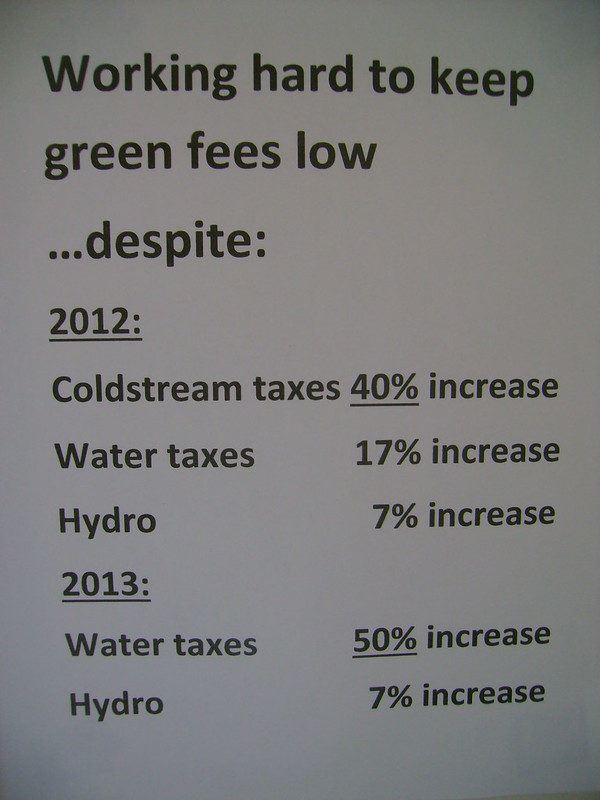 | ||||||||
| 3 levels of government, all within a 5-minute drive, lead to huge and burgeoning bureaucratic costs in the North Okanagan of B.C. The 2013 property tax increase is 4.12% |
The majority involved getting rid of government(s).
"I'd tend bar if I could," offers Kia.
Wednesday, March 20, 2013
Barry Beardsell Weighs In
Former Vernon councillor Beardsell's letter to the editor, March 17, 2013 entitled Fiscal Challenges Add Up to Say No (to the May referendum on the sports track at the College) tells it from an accounting and debt angle.
Affectionately called Dr. No during his council tenure, Barry is an accountant.
So he knows numbers.
And he knows planning processes that rely on numbers.
(Links were added by blog author).
"Greater Vernon is facing some difficult financial decisions regarding aging and inadequate recreational and cultural facilities. In addition, the future cost of maintaining and replacing city infrastructure is a major concern.
"...$7.5 million referendum funds...borrowed at 4.1 per cent interest ... sit in an account earning about 1 per cent interest. Meanwhile, we are making payments on the debt." Beardsell
There is demand for a new museum and art gallery. The politicians state that the need for a new pool be considered in 2014. Where would it be constructed? We are deficient in parks and facilities (we have no track and field facility). We are told that Civic Arena will need to be replaced very soon. Where will the replacement be constructed?
"...$13 million annual deficiency...infrastructure."
The obvious location is the area of Kin Race Track. The multiplex was built with an ice plant sufficient to handle two sheets of ice. Unfortunately, local government has allowed the horse racing issue to drag on for years with no resolution. Horse racing is in decline everywhere and Vernon is no exception. Kin Race Track needs to be set aside for a higher and better use. The issue was before the Supreme Court of B.C. and rather than letting the issue drag on forever, let the court make a determination.
Financially we should be aware of what many consider to be financial mismanagement:
- Another $100 million for required improvements to our water system.
- The gifting of $1 million of land to Okanagan Regional Library, with the result that the city had to purchase another property at a cost in excess of $1 million for the proposed 25th Avenue extension.
- The lack of transparency regarding the repairs to the venting system of the swimming pool. These repairs are necessary because of the complete failure of due diligence in the early 1990s.
- The failure of the regional district to implement new development cost charges at a cost to the taxpayers of $500,000.
- The fact that the $7.5 million referendum funds of 2003 have been borrowed at 4.1 per cent interest and they sit in a savings account earning about one per cent interest. Meanwhile, we are making payments on the debt.
- The City of Vernon assuming the full costs of maintaining Polson Park and assuming all future improvements even though it is used by most of the North Okanagan.
- The agreement whereby the city will transfer millions of dollars worth of our land to the regional district and give up voting rights on park matters.
We have incurred the debt of $10.5 million for the two floors at the hospital, will now have to borrow a further $5.5 million and have already taken on $59 million in debt related to the new hospital tower. This debt is just part of the $80 million that we are responsible for, along with the adjoining hospital district.
How will the city fund replacing city infrastructure over the next 15 years? There is an estimated $13 million annual deficiency related to our infrastructure.
The city is in the middle of a core review. It does not know how it can handle its existing financial problems. Local government must implement a comprehensive 10 year plan which must address and define our needs and what we can afford.
The formation of the North Okanagan Sports Society should be able to assist but our elected officials must take the lead.
Vote "no" in the upcoming referendum and then the politicians will be forced to take a more sensible approach and let the taxpayers make informed defisions and hopefully result in our community being financially affordable." Barry Beardsell
"Borrowed at 4.1 % and sitting in a 1% account," declares Kia, "sounds like NDP-trained bureaucrats are already here."
Thursday, March 14, 2013
Rolke Rollover
And it's nothing to do with a pension.
Simply put, Richard Rolke's op-ed piece in the Morning Star suggests keeping three local governments--within a five-minute drive of each other--because we'd still end up with two if amalgamation occurred.
That's akin to saying "yeah, my household has a lot of debt but since it's so hard to save $100 versus spending $100, we'll just carry on as we were." Even after those who know better have stated it's an inefficient and expensive way to operate.
His March 13, 2013 piece entitled "Don't expect panacea" is reprinted, slathered in bold with blog comments, starting with the awkward title that scored a mere 67 out of 100 on http://www.grammarly.com/.
"Don't expect a panacea" would be grammatically correct.
But I digress.
His piece:
"There's been a lot of talk about amalgamation since a consultant suggested that route would create efficiencies for Vernon." A consultant? KPMG, merely the highest rated among business professionals! And it began long before that report. The amalgamation issue--called governance review--was called by sometime-provincial-minister Ida Chong years before the KPMG report, as noted here and here and here and here! Rolke continues: "It's generated letters to the editor and some scuttle when politicians gather.
However, while merging Vernon, Coldstream and the two electoral areas appears simple on the surface, there are some key factors to consider.
Specifically, while many believe there would only be one level of governance instead of three, the reality is there would be two. Regional districts are mandated under provincial legislation and all municipalities must belong to one (even in the case of larger communities like Vancouver, Victoria and Kelowna)." KPMG knows that. It's the work of the NDP's two consecutive terms, which increased bureaucracy to previously unheard of levels. And will again.
"If Greater Vernon were to join together ...join together? (as in repeat again? redundant!) as a single entity, it would obviously take some current duties away from the Regional District of North Okanagan, such as water and parks and recreation." Historically, water was managed by the Vernon Irrigation District. Parks were dotted throughout communities, often adjacent to public schools, some lands were donated by pioneers; not funded by/forced on developers. Recreation? People got all the recreation they could handle operating farms and acreages. For those who sought more, private recreation facilities were available that had no competition from government (versus RDNO's recent plans to build a disc-golf facility at a park). Children rode several miles to school on bicycles...on roadsides, without the need for bicycle paths (at a time when there was a realization that the Okanagan had ~5 months of winter). Rolke omitted "culture"...so we'll add that for him. Culture was something grandparents did. And they did it well. Children learned gardening from their parents and grandparents, not a $10,000 a year Community Garden Coordinator. As to water "management", it now depends on how the wind blows: we spent $30 million on the Duteau Creek Water Treatment Plant ($12 million of which came from the Feds). Within two years, there is talk among politicians that a further $100 million is needed because "that wasn't the way to go" in addition to Interior Health wanting filtration.
"However, even under a diminished form, RDNO would remain as its purpose does not hinge on Greater Vernon alone. It is a collective of six municipalities in the North Okanagan and provides governance for the five electoral areas, which include rural Enderby, rural Lumby and Cherryville besides the two adjacent to Vernon." ...all able to be rearranged with sufficient will from residents fed up with continually increasing taxes, 50 per cent of which now go to bureacratic wages. (To compare, large retail food stores have a wage cost between nine and 10 per cent).
"Through that collective, a number of functions are provided." Many residents recall it took a month or two of several local governments chatting, after which they decided a responsibility would be called a "function", and what it would entail. "Among them is representation at Okanagan Basin Water Board, which focuses on water quality and quantity and attempts to control milfoil in our lakes."
The unelected Okanagan Basin Water Board, a relative newcomer in the scheme of things. The OBWB likely had considerable influence on Coldstream Councillor Kiss, who was reported to have met privately with water consultants and now proposes the transfer of a public asset--a water licence from the upland to Kal Lake. The reasons for Kiss' statement '(the transfer) may have some benefits' have never been made public in The Morning Star newspaper, let alone Coldstream Council minutes. One thing's for sure: the late Brian Harvey would roll over in his grave at the money mismanagement. Richard Rolke should do an in-depth story on the purported benefits of the water licence transfer -- but that would involve doing research, something he's averse to doing.
"The region, as a whole, is also looking at growth and how development occurs in the years to come. Housing, employment, transportation and the environment know no boundaries." "If" development occurs is more accurate, based on the RDNO's Growth Management Strategy. And the environment knows no boundaries? Exactly, as the multitude of burning regulations prove. The environment? No-one in our myriad local governments gets off their office-arse to head into the hills and prevent water contamination by the public on Crown lands adjacent to the water source.
"Perhaps the most important function, though, is solid waste. Under provincial legislation, it is regional districts, not municipalities, that are responsible for managing garbage and recycling. That scenario wouldn't change if Greater Vernon merges." Residents joke that the Mafia has taken over big-city garbage and recycling, so we'll leave that to them. As for the real waste generation--people poop--rural areas will never be on sewer. And shouldn't be.
"It's also interesting that talk of amalgamation comes while the City of Vernon has been warned about its infrastructure deficient -- a whopping $78 million." And Coldstream is in the clear? Nope.
Amalgamation would expand Vernon's tax base, but expenses and liabilities would also climb. All of a sudden, existing city residents would be on the hook for maintenance of sprawling roads throughout the BX and Commonage. Because electoral roads fall under the jurisdiction of the provincial government, many have been neglected for years." So how would residents be 'on the hook' if rural roads remain the provincial government's responsibility? It's one or the other, not both. "As an example of the potential burden, Vernon has experienced a significant cost for roads -- and meeting demands for urban standards -- since Okanagan Landing was absorbed 20 years ago." Urban standards...like nonsensical traffic circles--for which there's a $10,000 provincial 'grant'--yet their cost is ~30,000. Now Coldstream wants to do a traffic circle at Kal and Kidston Roads. (Sigh). The new Okanagan Landing Road that Vernon built is beautiful.
"If there is one positive from amalgamation, it could be the end of the fighting that flares up every few years within Greater Vernon. Obviously there would also be fewer bureaucratic hoops to jump through if development policies were handled by the same entity dealing with water and parks." Bureaucratic hoops...maybe new employers would actually consider locating here but they're caught in a maze of jurisdictions, quickly giving up to head south. If amalgamation had taken place 10 or so years ago when the question first arose...Coldstream would not now have a new municipal hall; nor would Coldstream be planning a Town Center. Residents didn't want that then, and they don't want a Town Center tomorrow. How many millions did that Hall cost? Now the new Mechanics Shop; all debt. Coldstream would today be the rural community we all knew 40 years ago, riders on horses meandering along the roadsides, waving to residents puttering in their yards. Not the cookie-cutter-city wannabe it is becoming because politicians are jumping at senior bureaucrats' planning wishlists at annual Union of B.C. Municipalities meetings. Residents are infuriated that councillors seem in lock-step with Victoria's demands for controlled communities.
"But, it should be pointed out, that presently, all three jurisdictions are working together and resolving outstanding concerns." The salient point is entirely missed. Residents don't care whether or not politicians or bureaucrats argue; we care about how much money three local governments need from residents and the debt they are acquiring despite residents' continuing opposition. We care deeply about over-governance and redundancy; we care about efficiency, as does the commissioned KPMG study. Many people recall that Coldstream spent $16,000 to landscape the traffic islands at Kal General Store! Sixteen thousand dollars for $500 worth of plants and $1,000 in irrigation plus labour! Absolutely ludicrous!
"And in terms of cost savings, all that would likely be trimmed are a few politicians and senior administrators. There would still be a need for the rank and file workers to meet public demands, which won't shrink just because there's fewer jurisdictions." Nobody's recommending thinning the 'rank and file', people who repair waterlines and plow roads. They provide the public with necessities. But many people wonder what duties a Traffic Demand Coordinator performs! Second-guessing KPMG has led to Rolke's conclusion of 'a few politicians and senior administrators', an entirely laughable conjecture.
"Ultimately, amalgamation of part or all of Greater Vernon may occur, but for anyone who believes this is the gateway to panacea, they may be disappointed." Or they may not. An earlier Rolke op-ed referred to Ottawa's amalgamation of 10 municipalities, now celebrating the 10th anniversary of their merger...and celebrating how much money is now available for worthwhile projects.
"Rolke's become a shill for Coldstream," suggests Kia, "rolling over like a puppy."
Residents will continue to watch politicians whose only focus is to kiss up to Victoria.
Because we can do something about that.
The only reasons amalgamation is ever suggested is due to burgeoning costs to residents (with little, if any, obvious benefit), and because Coldstream and Vernon are becoming communities controlled and directed by Victoria's wishlists.
We do miss the good ole' days here.
Wednesday, March 13, 2013
Mass Immigration = Reluctant Racists?
A stunningly frank article reprinted from the United Kingdom, from London's Telegraph:
"By Jane Kelly
Jane Kelly is consulting editor of the 'Salisbury Review’
"By Jane Kelly
29 Jan 2013
"When you go swimming, it’s much healthier to keep your whole
body completely covered, you know.”
The Muslim lady behind the counter in my local pharmacy has
recently started giving me advice like this. It’s kindly meant and I’m always glad to hear her views because
she is one of the few people in west London where I live who talks to me.
The streets around Acton, which has been my home since 1996, have
taken on a new identity. Most of the shops are now owned by Muslims and even the fish and
chip shop and Indian takeaway are Halal. It seems that almost overnight it’s changed from Acton
Vale into Acton Veil.
 |
| photo Jeff Gilbert |
Of the 8.17 million people in London, one million are Muslim, with
the majority of them young families. That is not, in reality, a great number. But because so many
Muslims increasingly insist on emphasising their separateness, it feels as if they have taken
over; my female neighbours flap past in full niqab, some so heavily veiled that I can’t see their eyes.
I’ve made an effort to communicate by smiling deliberately at the ones I thought I was seeing out and
about regularly, but this didn’t lead to conversation because they never look me in the face.
I recently went to the plainly named “Curtain Shop” and asked if
they would put some up for me. Inside were a lot of elderly Muslim men. I was told that they
don’t do that kind of work, and was back on the pavement within a few moments. I felt sure I had
suffered discrimination and was bewildered as I had been there previously when the Muslim owners
had been very friendly.
Things have changed. I am living in a place where I am a stranger.
I was brought up in a village in Staffordshire, and although I
have been in London for a quarter of a century I have kept the habit of chatting to shopkeepers and
neighbours, despite it not being the done thing in metropolitan life. Nowadays, though, most of the
tills in my local shops are manned by young Muslim men who mutter into their mobiles as they
are serving. They have no interest in talking to me and rarely meet my gaze. I
find this situation dismal. I miss banter, the hail fellow, well met chat about the weather,
or what was on TV last night.
More worryingly, I feel that public spaces are becoming contested.
One food store has recently installed a sign banning alcohol on the premises. Fair enough. But
it also says: “No alcohol allowed on the streets near this shop.” I am no fan of street drinking, and
rowdy behaviour and loutish individuals are an aspect of modern British ''culture’’ I hate. But I feel
uneasy that this shopkeeper wants to control the streets outside his shop. I asked him what he meant by
his notice but he just smiled at me wistfully. Perhaps he and his fellow Muslims want to turn the area into
another Tower Hamlets, the east London borough where ''suggestive’’ advertising is banned and last year a
woman was refused a job in a pharmacy
because she wasn’t veiled.
On the other hand, maybe I should be grateful. At least in Acton
there is just a sign in a shop. Since the start of the year there have been several reports from
around London of a more aggressive approach. Television news footage last week showed
incidents filmed on a mobile phone on a Saturday night, in the borough of Waltham Forest, of men
shouting “This is a Muslim area” at white Britons. The video commentary stated: “From women walking the street
dressed like complete naked animals with no self-respect, to drunk people carrying alcohol, we try our
best to capture and forbid it all.”
Another scene showed hooded youths forcing a man to drop his can
of lager, telling him they were the “Muslim patrol” and that alcohol is a “forbidden evil”. The gang
then approached a group of white girls enjoying a good night out, telling them to “forbid themselves from
dressing like this and exposing themselves outside the mosque”.
Worse, though, is film footage from last week, thought to have
been taken in Commercial Street, Whitechapel, which showed members of a group who also called
themselves a “Muslim patrol” harassing a man who appeared to be wearing make‑up, calling him a
“bloody fag”. In the video posted on YouTube last week, the passer-by is told he is “walking through
a Muslim area dressed like a fag” and ordered to get out. Last Thursday, police were reported to have
arrested five “vigilantes” suspected of homophobic abuse.
There are, of course, other Europeans in my area who may share my feelings
but I’m not able to talk to them easily about this situation as they are mostly immigrants, too. At
Christmas I spoke to an elderly white woman about the lack of parsnips in the local greengrocer, but she
turned out to have no English and I was left grumbling to myself.
Poles have settled in Ealing since the Second World War and are
well assimilated, but since 2004 about 370,000 east Europeans have arrived in London. Almost half the
populations of nearby Ealing and Hammersmith were born outside the UK. Not surprisingly, at my bus
stop I rarely hear English spoken.
I realise that we can’t return to the time when buses were mainly
occupied by white ladies in their best hats and gloves going shopping, but I do feel nostalgic for the
days when a journey on public transport didn’t leave me feeling as if I have only just arrived in a
strange country myself.
There are other “cultural differences” that bother me, too. Over
the past year I have been involved in rescuing a dog that was kept in a freezing shed for months. The owners
spoke no English. A Somali neighbour kept a dog that he told me he was training to fight, before it was stolen
by other dog fighters. I have tried to re-home several cats owned by a family who refuse to neuter their
animals, because of their religion.
In the Nineties, when I arrived, this part of Acton was a
traditional working-class area. Now there is no trace of any kind of community – that word so cherished by the Left.
Instead it has been transformed into a giant transit camp and is home to no one. The scale of immigration over
recent years has created communities throughout London that never need to – or want to –
interact with outsiders.
It wasn’t always the case: since the 1890s thousands of Jewish,
Irish, Afro-Caribbean, Asian and Chinese workers, among others, have arrived in the capital, often
displacing the indigenous population. Yes, there was hateful overt racism and discrimination, I’m not
denying that. But, over time, I believe we settled down into a happy mix of incorporation and shared
aspiration, with disparate peoples walking the same pavements but returning to very different homes –
something the Americans call “sundown segregation”.
But now, despite the wishful thinking of multiculturalists, wilful
segregation by immigrants is increasingly echoed by the white population – the rate of white flight from our cities
is soaring. According to the Office for National Statistics, 600,000 white Britons have left London in the
past 10 years. The latest census data shows the breakdown in telling detail: some London boroughs have
lost a quarter of their population of white, British people. The number in Redbridge, north London, for
example, has fallen by 40,844(to 96,253) in this period, while the total population has risen by more than
40,335 to 278,970. It isn’t only London boroughs. The market town of Wokingham in Berkshire has lost
nearly 5 per cent of its white British population.
I suspect that many white people in London and the Home Counties
now move house on the basis of ethnicity, especially if they have children. Estate agents don’t
advertise this self-segregation, of course. Instead there are polite codes for that kind of thing, such as the
mention of “a good school”, which I believe is code for “mainly white English”. Not surprising when
you learn that nearly one million pupils do not have English as a first language.
I, too, have decided to leave my area, following in the footsteps
of so many of my neighbours. I don’t really want to go. I worked long and hard to get to London, to find a
good job and buy a home and I’d like to stay here. But I’m a stranger on these streets and all the “good”
areas, with safe streets, nice housing and pleasant cafés, are beyond my reach.
I see London turning into a
place almost exclusively for poor immigrants and the very rich.
It’s sad that I am moving not for a positive reason, but to escape
something. I wonder whether I’ll tell the truth, if I’m asked. I can’t pretend that I’m worried about
local schools, so perhaps I’ll say it’s for the chance of a conversation over the garden fence. But really I
no longer need an excuse: mass immigration is making reluctant racists of us all."
Sunday, March 10, 2013
Commercial Irrigation Rates Skyrocket 50 Per Cent
Yup.
"Six businesses, including golf courses and nurseries in Vernon and Coldstream, will see the rate for irrigation water climb 50 per cent," announces the Morning Star today.
"Let the valley revert to desert as people leave..."
Maybe they're hoping we six businesses have a short memory, but we've been through this before--first in 2005, and then here, and here (now that Coldstream Councillor Gyula Kiss seems to be in charge of everything to do with water...including "some benefits" that might accrue from transfer of the area's water licence from upland sources to Kal Lake!)
Some benefits.
Might accrue.
Isn't a water licence a public asset and any plans to transfer it, or change it, or abandon it, or trade it must come before the public for approval?
There is little transparency in local governments in the North Okanagan, as no-one has ever said publicly (out of camera) what these so-called benefits are...
With Councillor Kiss meeting privately with the water consultants, is there any wonder Greater Vernon Water Authority Manager, Al Cotsworth, is retiring at the end of March? Probably has nothing to do now that Kiss has taken over.
Back to water rates.
Apart from the commercial rate hit, everyone else will see a 3 per cent increase in rates over 2012. As the Morning Star states, "customers who rarely turn on the tap will start paying more for water."
Proof it was never about conservation (shades of B.C. Hydro!)
Lumby's water rates are increasing too...seems people are conserving so much water that there's not enough revenue to run the utility.
"Why don't we just deactivate all the water lines," offers an acquaintance, "and let the valley revert to desert as people leave."
"Sounds like Sean Harvey is back," offers Kia.
(The six businesses are: Highlands Golf, Hillview Golf, Art Knapp's Nursery, Swan Lake Nursery, Tekmar Industries, and Atlantis Water Slides).
Friday, March 8, 2013
Idling Bylaw
Brilliant dissection of a ludicrous law.
A Letter to the Editor today, by K. Jameson, has people shaking their heads at Vernon Council's latest...
"Council's new anti-idling law will impose $1,000 after-tax fines on people for idling car engines for more than three minutes.
"That's a huge, life-affecting fine for some people,
for only a tiny offence." K. Jameson
At a tax rate of 25 per cent, you must earn $1,250 to pay the fine. Doing some simple minimum wage math, $10.25 times four weeks a month equals $1,640, minus maybe 25 per cent for tax and deductions, gives you about $1,230. So a bylaw person who waited around and caught someone idling their car for three minutes could wipe out an entire month of earnings for some people, or a half month of earnings for more fortunate people.
That's a huge, life-affecting fine for some people, for only a tiny offence. How tiny?
Let's do some more junior high school math to compare the quantity of offensive idling fumes to all the other car fumes that are produced in the city.
If the quantity of idling fumes is much smaller than the quantity of total fumes, then council's new anti-idling law is pointless, because it doesn't address the overall fumes problem in any meaningful way.
Let's use simple estimates for (1) the number of vehicles burning fuel, (2) their RPM (fuel burn) rates, (3) their engine sizes, and (4) the number of minutes running. Double the vehicles, the RPM, the engine size, or the minutes running, and you double the fumes produced.
(1) During rush hour, at a time when moms pick up their kids at school and offensively idle their engines, what percentage of running vehicles in Vernon are idling at the school? Common sense says that 10 per cent, or even five per cent, seem too high. So let's go with two per cent and assumed that one out of every 50 running vehicles is at the school, offensively idling, picking up a child. Already you can see that council's new anti-idling law is only addressing a maximum of two per cent (1/50) of the fumes problem. But it gets much worse.
(2) If idling vehicles run at about 1,000 RPM, and moving vehicles run at least 2,000 RPM, moving vehicles generate two times the fumes, increasing the total fumes by 2x. So Council's new law is now addressing one per cent of the fumes problem.
(3) The average engine size of a school mom's idling vehicle must be smaller than the average engine sie of the vehicles running elsewhere in town.
Think of all those huge diesel engines on the highway, and all of the V8 pickup and delivery trucks doing business in town. They pull the average engine size way up. For easy math, let's say the school moms' engine sizes are half the size of the trucks driving around town. Now council's new law is addressing 0.5 per cent or less of the fumes problem.
"...the unaware tourist victims who happen to stop
for three minutes and get fined $1,250 after-tax dollars
as they're passing through our friendly town."
K. Jameson
(4) Outside of school pickup minutes, the original two per cent of idling vehicles at schools drops to zero percent, and council's new law addresses a vanishingly small part -- let's be truthful and call it essentially zero per cent -- of the overall fumes problem because now all vehicles in Vernon, including school moms, continue to generate fumes whenever they are running.
The newspaper editor had it right when he pointed out various problems with bylaw definitions, enforcement, and with the legitimate reasons for why people keep their cars idling in the winter.
For example, to defrost their windshields so they can see through them to drive safely in the school zone.
I think of the unaware tourist victims who happen to stop for three minutes and get fined $1,250 after-tax dollars as they're passing through our friendly town.
Hopefully, everyone will soon learn to momentarily turn their car off and on again to stay under the three continuous minutes limit, and to thereby significantly reduce our valley-wide inversion air quality problems." K.Jameson
"I vote for K.Jameson to supervise future bylaw planning," offers Kia, "right after this one's relegated to the Round File."
Then K. Jameson can head over to Coldstream and do the same thing with theirs.
Subscribe to:
Posts (Atom)


