Sunday, April 28, 2013
Coldstream's OCP Never Gathers Dust
It's always open, yet officials say the last review was 7 years ago.
They're always reviewing it (checking for rules requirements/infractions).
Seven years is as though it were yesterday to residents who are constantly bombarded by stories of what Council is contemplating and doing. As in perhaps a roundabout on Kal Lake Road (loud groans), or maybe traffic lights (groan, groan). Many people I've spoken with simply groan, "plus a provincial election".
Written 20 years ago, Coldstream's Official Community Plan is being opened up (again for public input) at a time when the public remains distracted by a poor economy, lack of new employers and the jobs they would bring, not to mention their own family's focus on increasing property taxes, water rates, and hydro/gas rates.
Add up all the Variances (to the rules) that people apply for, you'd be correct in thinking nobody ever puts the Official Community Plan for Coldstream back on the shelf. It's always open.
Several open houses are planned for the public to provide input:
May 6th Coldstream Women's Institute 3-5 p.m., reconvening at 6:30-8:30 p.m.
May 8th Lavington Fire Hall, 3-5 p.m., and 6:30-8:30 p.m.
The Mayor states "We're looking at densities, agricultural lands and the uses that occur on them."
Several Coldstream Acreage Owner Association members quickly quipped "they'd better leave last year's RU10/RU30 plan buried, or we'll have to jump all over 'em again."
Other topics that Coldstream Council's review will consider in the Official Community Plan are listed below--followed by responses from Kia and our group:
* residential housing demands (single family, multi-family, retirement). Leave this to the private sector, as they know what they're doing, and whether it's viable.
* future community growth areas. Gawd, here we go again. After this same council has vehemently vetoed "mile long subdivisions", etc. etc. Unless the good Lord has granted Coldstream some new land, nothing has changed from the last time they studied it.
* residential/rural land-use interface planning. The Agricultural Land Commission has created details on a buffer zone for such an interface, so that's what will be applied. No point in reinventing the wheel unless you're Councillor Richard Enns, who is concerned riding arenas--if setback is reduced to 30 metres--will create a lot of dust. Jeezzuzz! Buy 'em a sprinkler.
*agricultural land use planning and farming viability. Yeah, sure, a bunch of bureaucrats and councillors (most of whom are decidedly left-of-center) are going to find the magic formula for farm viability.
As indicated during last year's RU10/RU30 debacle--this Council doesn't have a clue about farming the East Coldstream valley--yes, it's suitable chiefly for forage crops. Even apples (and certainly stone-fruit crops) don't work in the valley bottom where frost settles late winter/early spring from cold outflow winds from the Monashees.
* hillsides' long-term land-use planning. Reiterate Maria Besso's comment from last year: "We don't want mile long subdivisions". And presto, you won't get them...or their tax dollars.
* commercial neighbourhood centres. Ah...my favourite thing to hate. What merchant in his right mind is going to fly in the face of demographics--and revenue--and build a shop in Coldstream's proposed Town Centre? Not many. Not when every fifth retail space in Vernon has For Lease on the window. Oh, they'll get the odd dentist or chiropractor...
*industrial land availability. It was the Mayor who stated a year or two ago--after he had been asked if the former Consumers Glass Plant might be subdivided into smaller industrial parcels--that he preferred it to remain in one piece. Seems a film might be produced there. (Sigh).
*municipal parks and trails strategy. Needed for people who don't have acreage.
*sensitive ecosystems policy strategy. These rules will continue to arise in Victoria (where they should originate). Our Mayor should be focusing on a sensitive taxpayer's system policy.
*hazardous lands identification. TerraSoft, Google Earth and Google Maps = done! Like dinner!
Haven't seen any new Coldstream lands created recently, but the mountain opposite does look a bit taller.
*infrastructure planning (transportation, utilities, services). Even local MLA Eric Foster recently admitted that a community "can't do water separation/twinning alone", taxpayers don't want to ask for more services because of the cost.
*interjurisdictional land-use planning. Coldstream Council is a signatory to the Regional Growth Management Strategy, so they're bound by that, not by what we want to see. Plus we've stopped telling them what we want.
"Maybe we should tell DoC that many Japanese companies have 300 year plans," offers Kia, "and they stick to them."


Thursday, April 25, 2013
"Plentiful" Water Supply
Finally some good news from Greater Vernon Water.
As reported in the Morning Star on April 17, 2013, Duteau Creek's water content (in snow) is 109 per cent of average, with snow depth at 102 per cent.
The stored water volume of Duteau Creek reservoirs is 154 per cent.
The entire basin that includes Duteau Creek reservoirs is at 111 per cent.
The Okanagan-Kettle basin which includes the Kal Lake water source is at 107 per cent.
"So...nothing about rate decreases?" asks Kia.
Don't hold your breath waiting for that!
Weather system photos as they descend onto the Aberdeen Plateau are here.
As reported in the Morning Star on April 17, 2013, Duteau Creek's water content (in snow) is 109 per cent of average, with snow depth at 102 per cent.
The stored water volume of Duteau Creek reservoirs is 154 per cent.
The entire basin that includes Duteau Creek reservoirs is at 111 per cent.
The Okanagan-Kettle basin which includes the Kal Lake water source is at 107 per cent.
"So...nothing about rate decreases?" asks Kia.
Don't hold your breath waiting for that!
Weather system photos as they descend onto the Aberdeen Plateau are here.
Sunday, April 7, 2013
18% Voter Turnout at Referendum
And of that 18 per cent, 47.65 per cent said No, with 52.35 per cent saying Yes to borrowing $7.5 million for the Community Sports Facility adjacent to Okanagan College on Highway 97.
The perennial question after any vote is "Did the non-voters (36,875 in this case) favour the referendum?"
Or does the low voter turnout indicate yet more apathy among North Okanagan residents?
People should care, but often don't cast a ballot to support their opinion.
A total of 45,095 were eligible to vote.
"I'd better not hear any whining from any of the 82 percenters who didn't vote," asserts Kia.
The only aspect I'm personally dead against is that tenants--who do not own property--are permitted to vote in provincial borrowing referenda. And companies that operate in the area get no vote. That's the thoughtless manner in which voting rules are applied in British Columbia.
To calculate how much this sports facility will cost your family, here's the residential calculator.
Multiply that by the 20 year term.
And then hope that (municipal) interest rates remain low.
Saturday, March 30, 2013
Highlands Golf open for the season
Great weather (20C) for the Easter weekend.
Opening day was Good Friday.
Nice to see our regular customers again; good to know they're all a year older as well *grin*.
Lots of discussion ensued from the new clubhouse sign:
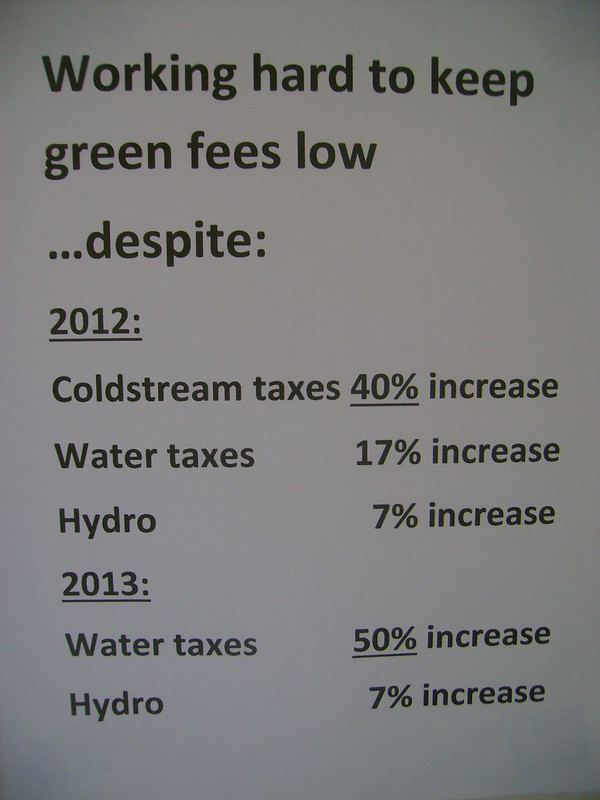 | ||||||||
| 3 levels of government, all within a 5-minute drive, lead to huge and burgeoning bureaucratic costs in the North Okanagan of B.C. The 2013 property tax increase is 4.12% |
The majority involved getting rid of government(s).
"I'd tend bar if I could," offers Kia.
Wednesday, March 20, 2013
Barry Beardsell Weighs In
Former Vernon councillor Beardsell's letter to the editor, March 17, 2013 entitled Fiscal Challenges Add Up to Say No (to the May referendum on the sports track at the College) tells it from an accounting and debt angle.
Affectionately called Dr. No during his council tenure, Barry is an accountant.
So he knows numbers.
And he knows planning processes that rely on numbers.
(Links were added by blog author).
"Greater Vernon is facing some difficult financial decisions regarding aging and inadequate recreational and cultural facilities. In addition, the future cost of maintaining and replacing city infrastructure is a major concern.
"...$7.5 million referendum funds...borrowed at 4.1 per cent interest ... sit in an account earning about 1 per cent interest. Meanwhile, we are making payments on the debt." Beardsell
There is demand for a new museum and art gallery. The politicians state that the need for a new pool be considered in 2014. Where would it be constructed? We are deficient in parks and facilities (we have no track and field facility). We are told that Civic Arena will need to be replaced very soon. Where will the replacement be constructed?
"...$13 million annual deficiency...infrastructure."
The obvious location is the area of Kin Race Track. The multiplex was built with an ice plant sufficient to handle two sheets of ice. Unfortunately, local government has allowed the horse racing issue to drag on for years with no resolution. Horse racing is in decline everywhere and Vernon is no exception. Kin Race Track needs to be set aside for a higher and better use. The issue was before the Supreme Court of B.C. and rather than letting the issue drag on forever, let the court make a determination.
Financially we should be aware of what many consider to be financial mismanagement:
- Another $100 million for required improvements to our water system.
- The gifting of $1 million of land to Okanagan Regional Library, with the result that the city had to purchase another property at a cost in excess of $1 million for the proposed 25th Avenue extension.
- The lack of transparency regarding the repairs to the venting system of the swimming pool. These repairs are necessary because of the complete failure of due diligence in the early 1990s.
- The failure of the regional district to implement new development cost charges at a cost to the taxpayers of $500,000.
- The fact that the $7.5 million referendum funds of 2003 have been borrowed at 4.1 per cent interest and they sit in a savings account earning about one per cent interest. Meanwhile, we are making payments on the debt.
- The City of Vernon assuming the full costs of maintaining Polson Park and assuming all future improvements even though it is used by most of the North Okanagan.
- The agreement whereby the city will transfer millions of dollars worth of our land to the regional district and give up voting rights on park matters.
We have incurred the debt of $10.5 million for the two floors at the hospital, will now have to borrow a further $5.5 million and have already taken on $59 million in debt related to the new hospital tower. This debt is just part of the $80 million that we are responsible for, along with the adjoining hospital district.
How will the city fund replacing city infrastructure over the next 15 years? There is an estimated $13 million annual deficiency related to our infrastructure.
The city is in the middle of a core review. It does not know how it can handle its existing financial problems. Local government must implement a comprehensive 10 year plan which must address and define our needs and what we can afford.
The formation of the North Okanagan Sports Society should be able to assist but our elected officials must take the lead.
Vote "no" in the upcoming referendum and then the politicians will be forced to take a more sensible approach and let the taxpayers make informed defisions and hopefully result in our community being financially affordable." Barry Beardsell
"Borrowed at 4.1 % and sitting in a 1% account," declares Kia, "sounds like NDP-trained bureaucrats are already here."
Thursday, March 14, 2013
Rolke Rollover
And it's nothing to do with a pension.
Simply put, Richard Rolke's op-ed piece in the Morning Star suggests keeping three local governments--within a five-minute drive of each other--because we'd still end up with two if amalgamation occurred.
That's akin to saying "yeah, my household has a lot of debt but since it's so hard to save $100 versus spending $100, we'll just carry on as we were." Even after those who know better have stated it's an inefficient and expensive way to operate.
His March 13, 2013 piece entitled "Don't expect panacea" is reprinted, slathered in bold with blog comments, starting with the awkward title that scored a mere 67 out of 100 on http://www.grammarly.com/.
"Don't expect a panacea" would be grammatically correct.
But I digress.
His piece:
"There's been a lot of talk about amalgamation since a consultant suggested that route would create efficiencies for Vernon." A consultant? KPMG, merely the highest rated among business professionals! And it began long before that report. The amalgamation issue--called governance review--was called by sometime-provincial-minister Ida Chong years before the KPMG report, as noted here and here and here and here! Rolke continues: "It's generated letters to the editor and some scuttle when politicians gather.
However, while merging Vernon, Coldstream and the two electoral areas appears simple on the surface, there are some key factors to consider.
Specifically, while many believe there would only be one level of governance instead of three, the reality is there would be two. Regional districts are mandated under provincial legislation and all municipalities must belong to one (even in the case of larger communities like Vancouver, Victoria and Kelowna)." KPMG knows that. It's the work of the NDP's two consecutive terms, which increased bureaucracy to previously unheard of levels. And will again.
"If Greater Vernon were to join together ...join together? (as in repeat again? redundant!) as a single entity, it would obviously take some current duties away from the Regional District of North Okanagan, such as water and parks and recreation." Historically, water was managed by the Vernon Irrigation District. Parks were dotted throughout communities, often adjacent to public schools, some lands were donated by pioneers; not funded by/forced on developers. Recreation? People got all the recreation they could handle operating farms and acreages. For those who sought more, private recreation facilities were available that had no competition from government (versus RDNO's recent plans to build a disc-golf facility at a park). Children rode several miles to school on bicycles...on roadsides, without the need for bicycle paths (at a time when there was a realization that the Okanagan had ~5 months of winter). Rolke omitted "culture"...so we'll add that for him. Culture was something grandparents did. And they did it well. Children learned gardening from their parents and grandparents, not a $10,000 a year Community Garden Coordinator. As to water "management", it now depends on how the wind blows: we spent $30 million on the Duteau Creek Water Treatment Plant ($12 million of which came from the Feds). Within two years, there is talk among politicians that a further $100 million is needed because "that wasn't the way to go" in addition to Interior Health wanting filtration.
"However, even under a diminished form, RDNO would remain as its purpose does not hinge on Greater Vernon alone. It is a collective of six municipalities in the North Okanagan and provides governance for the five electoral areas, which include rural Enderby, rural Lumby and Cherryville besides the two adjacent to Vernon." ...all able to be rearranged with sufficient will from residents fed up with continually increasing taxes, 50 per cent of which now go to bureacratic wages. (To compare, large retail food stores have a wage cost between nine and 10 per cent).
"Through that collective, a number of functions are provided." Many residents recall it took a month or two of several local governments chatting, after which they decided a responsibility would be called a "function", and what it would entail. "Among them is representation at Okanagan Basin Water Board, which focuses on water quality and quantity and attempts to control milfoil in our lakes."
The unelected Okanagan Basin Water Board, a relative newcomer in the scheme of things. The OBWB likely had considerable influence on Coldstream Councillor Kiss, who was reported to have met privately with water consultants and now proposes the transfer of a public asset--a water licence from the upland to Kal Lake. The reasons for Kiss' statement '(the transfer) may have some benefits' have never been made public in The Morning Star newspaper, let alone Coldstream Council minutes. One thing's for sure: the late Brian Harvey would roll over in his grave at the money mismanagement. Richard Rolke should do an in-depth story on the purported benefits of the water licence transfer -- but that would involve doing research, something he's averse to doing.
"The region, as a whole, is also looking at growth and how development occurs in the years to come. Housing, employment, transportation and the environment know no boundaries." "If" development occurs is more accurate, based on the RDNO's Growth Management Strategy. And the environment knows no boundaries? Exactly, as the multitude of burning regulations prove. The environment? No-one in our myriad local governments gets off their office-arse to head into the hills and prevent water contamination by the public on Crown lands adjacent to the water source.
"Perhaps the most important function, though, is solid waste. Under provincial legislation, it is regional districts, not municipalities, that are responsible for managing garbage and recycling. That scenario wouldn't change if Greater Vernon merges." Residents joke that the Mafia has taken over big-city garbage and recycling, so we'll leave that to them. As for the real waste generation--people poop--rural areas will never be on sewer. And shouldn't be.
"It's also interesting that talk of amalgamation comes while the City of Vernon has been warned about its infrastructure deficient -- a whopping $78 million." And Coldstream is in the clear? Nope.
Amalgamation would expand Vernon's tax base, but expenses and liabilities would also climb. All of a sudden, existing city residents would be on the hook for maintenance of sprawling roads throughout the BX and Commonage. Because electoral roads fall under the jurisdiction of the provincial government, many have been neglected for years." So how would residents be 'on the hook' if rural roads remain the provincial government's responsibility? It's one or the other, not both. "As an example of the potential burden, Vernon has experienced a significant cost for roads -- and meeting demands for urban standards -- since Okanagan Landing was absorbed 20 years ago." Urban standards...like nonsensical traffic circles--for which there's a $10,000 provincial 'grant'--yet their cost is ~30,000. Now Coldstream wants to do a traffic circle at Kal and Kidston Roads. (Sigh). The new Okanagan Landing Road that Vernon built is beautiful.
"If there is one positive from amalgamation, it could be the end of the fighting that flares up every few years within Greater Vernon. Obviously there would also be fewer bureaucratic hoops to jump through if development policies were handled by the same entity dealing with water and parks." Bureaucratic hoops...maybe new employers would actually consider locating here but they're caught in a maze of jurisdictions, quickly giving up to head south. If amalgamation had taken place 10 or so years ago when the question first arose...Coldstream would not now have a new municipal hall; nor would Coldstream be planning a Town Center. Residents didn't want that then, and they don't want a Town Center tomorrow. How many millions did that Hall cost? Now the new Mechanics Shop; all debt. Coldstream would today be the rural community we all knew 40 years ago, riders on horses meandering along the roadsides, waving to residents puttering in their yards. Not the cookie-cutter-city wannabe it is becoming because politicians are jumping at senior bureaucrats' planning wishlists at annual Union of B.C. Municipalities meetings. Residents are infuriated that councillors seem in lock-step with Victoria's demands for controlled communities.
"But, it should be pointed out, that presently, all three jurisdictions are working together and resolving outstanding concerns." The salient point is entirely missed. Residents don't care whether or not politicians or bureaucrats argue; we care about how much money three local governments need from residents and the debt they are acquiring despite residents' continuing opposition. We care deeply about over-governance and redundancy; we care about efficiency, as does the commissioned KPMG study. Many people recall that Coldstream spent $16,000 to landscape the traffic islands at Kal General Store! Sixteen thousand dollars for $500 worth of plants and $1,000 in irrigation plus labour! Absolutely ludicrous!
"And in terms of cost savings, all that would likely be trimmed are a few politicians and senior administrators. There would still be a need for the rank and file workers to meet public demands, which won't shrink just because there's fewer jurisdictions." Nobody's recommending thinning the 'rank and file', people who repair waterlines and plow roads. They provide the public with necessities. But many people wonder what duties a Traffic Demand Coordinator performs! Second-guessing KPMG has led to Rolke's conclusion of 'a few politicians and senior administrators', an entirely laughable conjecture.
"Ultimately, amalgamation of part or all of Greater Vernon may occur, but for anyone who believes this is the gateway to panacea, they may be disappointed." Or they may not. An earlier Rolke op-ed referred to Ottawa's amalgamation of 10 municipalities, now celebrating the 10th anniversary of their merger...and celebrating how much money is now available for worthwhile projects.
"Rolke's become a shill for Coldstream," suggests Kia, "rolling over like a puppy."
Residents will continue to watch politicians whose only focus is to kiss up to Victoria.
Because we can do something about that.
The only reasons amalgamation is ever suggested is due to burgeoning costs to residents (with little, if any, obvious benefit), and because Coldstream and Vernon are becoming communities controlled and directed by Victoria's wishlists.
We do miss the good ole' days here.
Simply put, Richard Rolke's op-ed piece in the Morning Star suggests keeping three local governments--within a five-minute drive of each other--because we'd still end up with two if amalgamation occurred.
That's akin to saying "yeah, my household has a lot of debt but since it's so hard to save $100 versus spending $100, we'll just carry on as we were." Even after those who know better have stated it's an inefficient and expensive way to operate.
His March 13, 2013 piece entitled "Don't expect panacea" is reprinted, slathered in bold with blog comments, starting with the awkward title that scored a mere 67 out of 100 on http://www.grammarly.com/.
"Don't expect a panacea" would be grammatically correct.
But I digress.
His piece:
"There's been a lot of talk about amalgamation since a consultant suggested that route would create efficiencies for Vernon." A consultant? KPMG, merely the highest rated among business professionals! And it began long before that report. The amalgamation issue--called governance review--was called by sometime-provincial-minister Ida Chong years before the KPMG report, as noted here and here and here and here! Rolke continues: "It's generated letters to the editor and some scuttle when politicians gather.
However, while merging Vernon, Coldstream and the two electoral areas appears simple on the surface, there are some key factors to consider.
Specifically, while many believe there would only be one level of governance instead of three, the reality is there would be two. Regional districts are mandated under provincial legislation and all municipalities must belong to one (even in the case of larger communities like Vancouver, Victoria and Kelowna)." KPMG knows that. It's the work of the NDP's two consecutive terms, which increased bureaucracy to previously unheard of levels. And will again.
"If Greater Vernon were to join together ...join together? (as in repeat again? redundant!) as a single entity, it would obviously take some current duties away from the Regional District of North Okanagan, such as water and parks and recreation." Historically, water was managed by the Vernon Irrigation District. Parks were dotted throughout communities, often adjacent to public schools, some lands were donated by pioneers; not funded by/forced on developers. Recreation? People got all the recreation they could handle operating farms and acreages. For those who sought more, private recreation facilities were available that had no competition from government (versus RDNO's recent plans to build a disc-golf facility at a park). Children rode several miles to school on bicycles...on roadsides, without the need for bicycle paths (at a time when there was a realization that the Okanagan had ~5 months of winter). Rolke omitted "culture"...so we'll add that for him. Culture was something grandparents did. And they did it well. Children learned gardening from their parents and grandparents, not a $10,000 a year Community Garden Coordinator. As to water "management", it now depends on how the wind blows: we spent $30 million on the Duteau Creek Water Treatment Plant ($12 million of which came from the Feds). Within two years, there is talk among politicians that a further $100 million is needed because "that wasn't the way to go" in addition to Interior Health wanting filtration.
"However, even under a diminished form, RDNO would remain as its purpose does not hinge on Greater Vernon alone. It is a collective of six municipalities in the North Okanagan and provides governance for the five electoral areas, which include rural Enderby, rural Lumby and Cherryville besides the two adjacent to Vernon." ...all able to be rearranged with sufficient will from residents fed up with continually increasing taxes, 50 per cent of which now go to bureacratic wages. (To compare, large retail food stores have a wage cost between nine and 10 per cent).
"Through that collective, a number of functions are provided." Many residents recall it took a month or two of several local governments chatting, after which they decided a responsibility would be called a "function", and what it would entail. "Among them is representation at Okanagan Basin Water Board, which focuses on water quality and quantity and attempts to control milfoil in our lakes."
The unelected Okanagan Basin Water Board, a relative newcomer in the scheme of things. The OBWB likely had considerable influence on Coldstream Councillor Kiss, who was reported to have met privately with water consultants and now proposes the transfer of a public asset--a water licence from the upland to Kal Lake. The reasons for Kiss' statement '(the transfer) may have some benefits' have never been made public in The Morning Star newspaper, let alone Coldstream Council minutes. One thing's for sure: the late Brian Harvey would roll over in his grave at the money mismanagement. Richard Rolke should do an in-depth story on the purported benefits of the water licence transfer -- but that would involve doing research, something he's averse to doing.
"The region, as a whole, is also looking at growth and how development occurs in the years to come. Housing, employment, transportation and the environment know no boundaries." "If" development occurs is more accurate, based on the RDNO's Growth Management Strategy. And the environment knows no boundaries? Exactly, as the multitude of burning regulations prove. The environment? No-one in our myriad local governments gets off their office-arse to head into the hills and prevent water contamination by the public on Crown lands adjacent to the water source.
"Perhaps the most important function, though, is solid waste. Under provincial legislation, it is regional districts, not municipalities, that are responsible for managing garbage and recycling. That scenario wouldn't change if Greater Vernon merges." Residents joke that the Mafia has taken over big-city garbage and recycling, so we'll leave that to them. As for the real waste generation--people poop--rural areas will never be on sewer. And shouldn't be.
"It's also interesting that talk of amalgamation comes while the City of Vernon has been warned about its infrastructure deficient -- a whopping $78 million." And Coldstream is in the clear? Nope.
Amalgamation would expand Vernon's tax base, but expenses and liabilities would also climb. All of a sudden, existing city residents would be on the hook for maintenance of sprawling roads throughout the BX and Commonage. Because electoral roads fall under the jurisdiction of the provincial government, many have been neglected for years." So how would residents be 'on the hook' if rural roads remain the provincial government's responsibility? It's one or the other, not both. "As an example of the potential burden, Vernon has experienced a significant cost for roads -- and meeting demands for urban standards -- since Okanagan Landing was absorbed 20 years ago." Urban standards...like nonsensical traffic circles--for which there's a $10,000 provincial 'grant'--yet their cost is ~30,000. Now Coldstream wants to do a traffic circle at Kal and Kidston Roads. (Sigh). The new Okanagan Landing Road that Vernon built is beautiful.
"If there is one positive from amalgamation, it could be the end of the fighting that flares up every few years within Greater Vernon. Obviously there would also be fewer bureaucratic hoops to jump through if development policies were handled by the same entity dealing with water and parks." Bureaucratic hoops...maybe new employers would actually consider locating here but they're caught in a maze of jurisdictions, quickly giving up to head south. If amalgamation had taken place 10 or so years ago when the question first arose...Coldstream would not now have a new municipal hall; nor would Coldstream be planning a Town Center. Residents didn't want that then, and they don't want a Town Center tomorrow. How many millions did that Hall cost? Now the new Mechanics Shop; all debt. Coldstream would today be the rural community we all knew 40 years ago, riders on horses meandering along the roadsides, waving to residents puttering in their yards. Not the cookie-cutter-city wannabe it is becoming because politicians are jumping at senior bureaucrats' planning wishlists at annual Union of B.C. Municipalities meetings. Residents are infuriated that councillors seem in lock-step with Victoria's demands for controlled communities.
"But, it should be pointed out, that presently, all three jurisdictions are working together and resolving outstanding concerns." The salient point is entirely missed. Residents don't care whether or not politicians or bureaucrats argue; we care about how much money three local governments need from residents and the debt they are acquiring despite residents' continuing opposition. We care deeply about over-governance and redundancy; we care about efficiency, as does the commissioned KPMG study. Many people recall that Coldstream spent $16,000 to landscape the traffic islands at Kal General Store! Sixteen thousand dollars for $500 worth of plants and $1,000 in irrigation plus labour! Absolutely ludicrous!
"And in terms of cost savings, all that would likely be trimmed are a few politicians and senior administrators. There would still be a need for the rank and file workers to meet public demands, which won't shrink just because there's fewer jurisdictions." Nobody's recommending thinning the 'rank and file', people who repair waterlines and plow roads. They provide the public with necessities. But many people wonder what duties a Traffic Demand Coordinator performs! Second-guessing KPMG has led to Rolke's conclusion of 'a few politicians and senior administrators', an entirely laughable conjecture.
"Ultimately, amalgamation of part or all of Greater Vernon may occur, but for anyone who believes this is the gateway to panacea, they may be disappointed." Or they may not. An earlier Rolke op-ed referred to Ottawa's amalgamation of 10 municipalities, now celebrating the 10th anniversary of their merger...and celebrating how much money is now available for worthwhile projects.
"Rolke's become a shill for Coldstream," suggests Kia, "rolling over like a puppy."
Residents will continue to watch politicians whose only focus is to kiss up to Victoria.
Because we can do something about that.
The only reasons amalgamation is ever suggested is due to burgeoning costs to residents (with little, if any, obvious benefit), and because Coldstream and Vernon are becoming communities controlled and directed by Victoria's wishlists.
We do miss the good ole' days here.
Wednesday, March 13, 2013
Mass Immigration = Reluctant Racists?
A stunningly frank article reprinted from the United Kingdom, from London's Telegraph:
"By Jane Kelly
Jane Kelly is consulting editor of the 'Salisbury Review’
"By Jane Kelly
29 Jan 2013
"When you go swimming, it’s much healthier to keep your whole
body completely covered, you know.”
The Muslim lady behind the counter in my local pharmacy has
recently started giving me advice like this. It’s kindly meant and I’m always glad to hear her views because
she is one of the few people in west London where I live who talks to me.
The streets around Acton, which has been my home since 1996, have
taken on a new identity. Most of the shops are now owned by Muslims and even the fish and
chip shop and Indian takeaway are Halal. It seems that almost overnight it’s changed from Acton
Vale into Acton Veil.
 |
| photo Jeff Gilbert |
Of the 8.17 million people in London, one million are Muslim, with
the majority of them young families. That is not, in reality, a great number. But because so many
Muslims increasingly insist on emphasising their separateness, it feels as if they have taken
over; my female neighbours flap past in full niqab, some so heavily veiled that I can’t see their eyes.
I’ve made an effort to communicate by smiling deliberately at the ones I thought I was seeing out and
about regularly, but this didn’t lead to conversation because they never look me in the face.
I recently went to the plainly named “Curtain Shop” and asked if
they would put some up for me. Inside were a lot of elderly Muslim men. I was told that they
don’t do that kind of work, and was back on the pavement within a few moments. I felt sure I had
suffered discrimination and was bewildered as I had been there previously when the Muslim owners
had been very friendly.
Things have changed. I am living in a place where I am a stranger.
I was brought up in a village in Staffordshire, and although I
have been in London for a quarter of a century I have kept the habit of chatting to shopkeepers and
neighbours, despite it not being the done thing in metropolitan life. Nowadays, though, most of the
tills in my local shops are manned by young Muslim men who mutter into their mobiles as they
are serving. They have no interest in talking to me and rarely meet my gaze. I
find this situation dismal. I miss banter, the hail fellow, well met chat about the weather,
or what was on TV last night.
More worryingly, I feel that public spaces are becoming contested.
One food store has recently installed a sign banning alcohol on the premises. Fair enough. But
it also says: “No alcohol allowed on the streets near this shop.” I am no fan of street drinking, and
rowdy behaviour and loutish individuals are an aspect of modern British ''culture’’ I hate. But I feel
uneasy that this shopkeeper wants to control the streets outside his shop. I asked him what he meant by
his notice but he just smiled at me wistfully. Perhaps he and his fellow Muslims want to turn the area into
another Tower Hamlets, the east London borough where ''suggestive’’ advertising is banned and last year a
woman was refused a job in a pharmacy
because she wasn’t veiled.
On the other hand, maybe I should be grateful. At least in Acton
there is just a sign in a shop. Since the start of the year there have been several reports from
around London of a more aggressive approach. Television news footage last week showed
incidents filmed on a mobile phone on a Saturday night, in the borough of Waltham Forest, of men
shouting “This is a Muslim area” at white Britons. The video commentary stated: “From women walking the street
dressed like complete naked animals with no self-respect, to drunk people carrying alcohol, we try our
best to capture and forbid it all.”
Another scene showed hooded youths forcing a man to drop his can
of lager, telling him they were the “Muslim patrol” and that alcohol is a “forbidden evil”. The gang
then approached a group of white girls enjoying a good night out, telling them to “forbid themselves from
dressing like this and exposing themselves outside the mosque”.
Worse, though, is film footage from last week, thought to have
been taken in Commercial Street, Whitechapel, which showed members of a group who also called
themselves a “Muslim patrol” harassing a man who appeared to be wearing make‑up, calling him a
“bloody fag”. In the video posted on YouTube last week, the passer-by is told he is “walking through
a Muslim area dressed like a fag” and ordered to get out. Last Thursday, police were reported to have
arrested five “vigilantes” suspected of homophobic abuse.
There are, of course, other Europeans in my area who may share my feelings
but I’m not able to talk to them easily about this situation as they are mostly immigrants, too. At
Christmas I spoke to an elderly white woman about the lack of parsnips in the local greengrocer, but she
turned out to have no English and I was left grumbling to myself.
Poles have settled in Ealing since the Second World War and are
well assimilated, but since 2004 about 370,000 east Europeans have arrived in London. Almost half the
populations of nearby Ealing and Hammersmith were born outside the UK. Not surprisingly, at my bus
stop I rarely hear English spoken.
I realise that we can’t return to the time when buses were mainly
occupied by white ladies in their best hats and gloves going shopping, but I do feel nostalgic for the
days when a journey on public transport didn’t leave me feeling as if I have only just arrived in a
strange country myself.
There are other “cultural differences” that bother me, too. Over
the past year I have been involved in rescuing a dog that was kept in a freezing shed for months. The owners
spoke no English. A Somali neighbour kept a dog that he told me he was training to fight, before it was stolen
by other dog fighters. I have tried to re-home several cats owned by a family who refuse to neuter their
animals, because of their religion.
In the Nineties, when I arrived, this part of Acton was a
traditional working-class area. Now there is no trace of any kind of community – that word so cherished by the Left.
Instead it has been transformed into a giant transit camp and is home to no one. The scale of immigration over
recent years has created communities throughout London that never need to – or want to –
interact with outsiders.
It wasn’t always the case: since the 1890s thousands of Jewish,
Irish, Afro-Caribbean, Asian and Chinese workers, among others, have arrived in the capital, often
displacing the indigenous population. Yes, there was hateful overt racism and discrimination, I’m not
denying that. But, over time, I believe we settled down into a happy mix of incorporation and shared
aspiration, with disparate peoples walking the same pavements but returning to very different homes –
something the Americans call “sundown segregation”.
But now, despite the wishful thinking of multiculturalists, wilful
segregation by immigrants is increasingly echoed by the white population – the rate of white flight from our cities
is soaring. According to the Office for National Statistics, 600,000 white Britons have left London in the
past 10 years. The latest census data shows the breakdown in telling detail: some London boroughs have
lost a quarter of their population of white, British people. The number in Redbridge, north London, for
example, has fallen by 40,844(to 96,253) in this period, while the total population has risen by more than
40,335 to 278,970. It isn’t only London boroughs. The market town of Wokingham in Berkshire has lost
nearly 5 per cent of its white British population.
I suspect that many white people in London and the Home Counties
now move house on the basis of ethnicity, especially if they have children. Estate agents don’t
advertise this self-segregation, of course. Instead there are polite codes for that kind of thing, such as the
mention of “a good school”, which I believe is code for “mainly white English”. Not surprising when
you learn that nearly one million pupils do not have English as a first language.
I, too, have decided to leave my area, following in the footsteps
of so many of my neighbours. I don’t really want to go. I worked long and hard to get to London, to find a
good job and buy a home and I’d like to stay here. But I’m a stranger on these streets and all the “good”
areas, with safe streets, nice housing and pleasant cafés, are beyond my reach.
I see London turning into a
place almost exclusively for poor immigrants and the very rich.
It’s sad that I am moving not for a positive reason, but to escape
something. I wonder whether I’ll tell the truth, if I’m asked. I can’t pretend that I’m worried about
local schools, so perhaps I’ll say it’s for the chance of a conversation over the garden fence. But really I
no longer need an excuse: mass immigration is making reluctant racists of us all."
Sunday, March 10, 2013
Commercial Irrigation Rates Skyrocket 50 Per Cent
Yup.
"Six businesses, including golf courses and nurseries in Vernon and Coldstream, will see the rate for irrigation water climb 50 per cent," announces the Morning Star today.
"Let the valley revert to desert as people leave..."
Maybe they're hoping we six businesses have a short memory, but we've been through this before--first in 2005, and then here, and here (now that Coldstream Councillor Gyula Kiss seems to be in charge of everything to do with water...including "some benefits" that might accrue from transfer of the area's water licence from upland sources to Kal Lake!)
Some benefits.
Might accrue.
Isn't a water licence a public asset and any plans to transfer it, or change it, or abandon it, or trade it must come before the public for approval?
There is little transparency in local governments in the North Okanagan, as no-one has ever said publicly (out of camera) what these so-called benefits are...
With Councillor Kiss meeting privately with the water consultants, is there any wonder Greater Vernon Water Authority Manager, Al Cotsworth, is retiring at the end of March? Probably has nothing to do now that Kiss has taken over.
Back to water rates.
Apart from the commercial rate hit, everyone else will see a 3 per cent increase in rates over 2012. As the Morning Star states, "customers who rarely turn on the tap will start paying more for water."
Proof it was never about conservation (shades of B.C. Hydro!)
Lumby's water rates are increasing too...seems people are conserving so much water that there's not enough revenue to run the utility.
"Why don't we just deactivate all the water lines," offers an acquaintance, "and let the valley revert to desert as people leave."
"Sounds like Sean Harvey is back," offers Kia.
(The six businesses are: Highlands Golf, Hillview Golf, Art Knapp's Nursery, Swan Lake Nursery, Tekmar Industries, and Atlantis Water Slides).
Friday, March 8, 2013
Idling Bylaw
Brilliant dissection of a ludicrous law.
A Letter to the Editor today, by K. Jameson, has people shaking their heads at Vernon Council's latest...
"Council's new anti-idling law will impose $1,000 after-tax fines on people for idling car engines for more than three minutes.
"That's a huge, life-affecting fine for some people,
for only a tiny offence." K. Jameson
At a tax rate of 25 per cent, you must earn $1,250 to pay the fine. Doing some simple minimum wage math, $10.25 times four weeks a month equals $1,640, minus maybe 25 per cent for tax and deductions, gives you about $1,230. So a bylaw person who waited around and caught someone idling their car for three minutes could wipe out an entire month of earnings for some people, or a half month of earnings for more fortunate people.
That's a huge, life-affecting fine for some people, for only a tiny offence. How tiny?
Let's do some more junior high school math to compare the quantity of offensive idling fumes to all the other car fumes that are produced in the city.
If the quantity of idling fumes is much smaller than the quantity of total fumes, then council's new anti-idling law is pointless, because it doesn't address the overall fumes problem in any meaningful way.
Let's use simple estimates for (1) the number of vehicles burning fuel, (2) their RPM (fuel burn) rates, (3) their engine sizes, and (4) the number of minutes running. Double the vehicles, the RPM, the engine size, or the minutes running, and you double the fumes produced.
(1) During rush hour, at a time when moms pick up their kids at school and offensively idle their engines, what percentage of running vehicles in Vernon are idling at the school? Common sense says that 10 per cent, or even five per cent, seem too high. So let's go with two per cent and assumed that one out of every 50 running vehicles is at the school, offensively idling, picking up a child. Already you can see that council's new anti-idling law is only addressing a maximum of two per cent (1/50) of the fumes problem. But it gets much worse.
(2) If idling vehicles run at about 1,000 RPM, and moving vehicles run at least 2,000 RPM, moving vehicles generate two times the fumes, increasing the total fumes by 2x. So Council's new law is now addressing one per cent of the fumes problem.
(3) The average engine size of a school mom's idling vehicle must be smaller than the average engine sie of the vehicles running elsewhere in town.
Think of all those huge diesel engines on the highway, and all of the V8 pickup and delivery trucks doing business in town. They pull the average engine size way up. For easy math, let's say the school moms' engine sizes are half the size of the trucks driving around town. Now council's new law is addressing 0.5 per cent or less of the fumes problem.
"...the unaware tourist victims who happen to stop
for three minutes and get fined $1,250 after-tax dollars
as they're passing through our friendly town."
K. Jameson
(4) Outside of school pickup minutes, the original two per cent of idling vehicles at schools drops to zero percent, and council's new law addresses a vanishingly small part -- let's be truthful and call it essentially zero per cent -- of the overall fumes problem because now all vehicles in Vernon, including school moms, continue to generate fumes whenever they are running.
The newspaper editor had it right when he pointed out various problems with bylaw definitions, enforcement, and with the legitimate reasons for why people keep their cars idling in the winter.
For example, to defrost their windshields so they can see through them to drive safely in the school zone.
I think of the unaware tourist victims who happen to stop for three minutes and get fined $1,250 after-tax dollars as they're passing through our friendly town.
Hopefully, everyone will soon learn to momentarily turn their car off and on again to stay under the three continuous minutes limit, and to thereby significantly reduce our valley-wide inversion air quality problems." K.Jameson
"I vote for K.Jameson to supervise future bylaw planning," offers Kia, "right after this one's relegated to the Round File."
Then K. Jameson can head over to Coldstream and do the same thing with theirs.
Wednesday, March 6, 2013
Water Meter Readings
NOTE: The most recent water meter readings are at the bottom of this page.
Duncan McDonald's comments here indicated Coldstream's water bills should--but do not--state the date the meter was read, especially the January to March readings each year. That's the Quarter used for billing residents' annual sewer rates.
So for future reference, I'll record here when meter readings are made by Coldstream staff (if I notice the meter reader arriving).
Three meters exist here: residence, clubhouse, and the irrigation meter.
We remove the irrigation meter at the end of irrigation season (usually end-September), store it in the clubhouse, and reinstall it around the end of March annually.
(Private fire hydrant "tax" costs: 2011 = $383.80; 2012 = $454.38; 2013 = $472.29; 2014 = $560.)
Edit: 2016 The horrendous costs of the private unmetered fire hydrant have been successfully challenged, and now are charged at $33.00 per quarter for a total of $132.00 a year).
Meters read March 4, 2013: clubhouse and residence, irrigation
Invoices received week of April 8, 2013:
Residence:
Pd Jan. 1/13 to Mar. 31/13, Wtr Base $78.12, Wtr Cons $7.84, total bill $85.96 for 28m3 consumption.
Clubhouse:
Pd Jan.1/13 to Mar. 31/13, Wtr Base $78.12, Wtr Cons $78.25, total $156.37 for 0m3 consumption.
Irrigation:
Pd Jan.1/13 to Mar. 31/13, Wtr Consumption $211.10, for 0m3 consumption.
TOTAL 1st QUARTER: $453.43 for 28m3, equals $16.20 per cubic meter of water consumed (OF 28 M3)!
Meters read June 4, 2013: clubhouse, residence, and irrigation
Invoices received week of July 9, 2013:
Residence:
Period April 1/13 to June 30/13, Wtr Base $80.50, Wtr Cons. $34.00, total bill $114.50 for 40m3 consumption.
Clubhouse:
Pd. April 1/13 to June 30/13, Wtr Base $80.50, Wtr Cons. $80.60, total bill $161.10 for 14 m3 consumption.
Irrigation:
Pd. Apr 1/13 to June 30/13, Wtr Base Min $80.50, Wtr Cons. 1141 cubic metres, $650.45
TOTAL 2nd QUARTER: $926.05 for 54m3, equals $17.15 per cubic meter of water consumed!
Meters read Sept. 5, 2013: clubhouse, residence, and irrigation
Invoices received October 3, 2013:
Residence:
Period July 1/13 to Sept. 30/13, Wtr Base $80.50, Wtr. Cons. $159.60, total bill $240.10 for 122m3 consumption.
Clubhouse:
Pd. July 1/13 to Sept. 30/13, Wtr Base $80.50, Wtr. Cons. $80.60., total bill $161.10 for 23 m3 consumption.
Irrigation:
Pd. July 13/13 to Sept. 30/13, Wtr Base Min $80.50. Wtr Cons. 2,021 cubic metres, $1,090.95
Private Fire Hydrant "Tax": $472.29
TOTAL 3rd QUARTER for 2166 m3 (incl. hydrant tax): $1,964.44, equals $.90 per cubic meter of water consumed!
Meters read Dec. 3, 2013: clubhouse, residence and irrigation
Invoices received January 9, 2014:
Residence:
Pd. Oct. 1/13 to Dec. 31/13: Wtr Base $80.50, Wtr. Cons. $25.00, total bill $105.50 for 31m3 consumption.
Clubhouse:
Pd. Oct. 1/13 to Dec. 31/13: Wtr Base $80.50, Wtr. Cons. $80.60, total bill $161.10 for 6 m3 consumption.
Irrigation:
Pd. Oct. 1/13 to Dec. 31/13: Wtr Base $80.50, Wtr. Cons. $217.45, total bill $297.95 for ZERO m3 consumption.
TOTAL 4th QUARTER: $564.55 for 37m3, equals $15.26 per cubic meter of water consumed!
2013 YEAR COST: $3,908.47, or $1.71 per cubic meter of water.
Meters read March 6, 2014: clubhouse, residence, irrigation. Invoices received April 8, 2014:
Residence:
Pd. Jan. 1/14 to Mar.31/14: Wtr Base $80.50, Wtr. Cons. $23.00, total bill $103.50 for 29m3 consumption.
Clubhouse:
Pd. Jan. 1/14 to Mar.31/14: Wtr Base $80.50, Wtr. Cons. $80.60, total bill $161.10 for ZERO m3 consumption.
Irrigation:
Pd. Jan. 1/14 to Mar.31/14: Wtr Base $80.50, Wtr. Cons. $217.45, total bill $297.95 for ZERO m3 consumption.
TOTAL 1st QUARTER: $562.55, equals $19.40 per cubic meter of water consumed!
Meters read June 3, 2014: clubhouse, residence, irrigation. Invoices received July 8, 2014:
Residence:
Apr. 1/14 to June 30/14: Wtr Base $99.80, Wtr. Cons. $25.10, total bill $124.90 for 28 m3 consumption.
Clubhouse:
Apr. 1/14 to June 30/14: Wtr Base $99.80, Wtr. Cons. $38.00, total bill $137.80 for 12 m3 consumption.
Irrigation:
Apr. 1/14 to June 30/14: Wtr Base Min $99.80, Wtr. Cons. $322.00, total bill $421.80 for 430 m3 consumption.
Private Fire Hydrant "Tax" (challenged at RDNO/District of Coldstream). GVAC asking Engineering for a review of private fire hydrant rates. Highlands offer to donate private fire hydrant to (1) Coldstream, (2) GVW rejected. Subsequently, no invoice received this year, slated to have been $560.00 (up from $472 in 2013).* NOTE: INVOICE FOR $560.00 RECEIVED AT YEAR END 2014!
TOTAL 2nd QUARTER: $684.50, equals $1.46 per cubic meter of water consumed!
Meters read Sept. 3, 2014: clubhouse, residence, irrigation.
Invoices received early Oct., 2014:
Residence:
July 1/14 to Sept. 30/14: Wtr base $99.80, Consumption $65.00, total bill $164.80 for 57 m3.
Clubhouse:
July 1/14 to Sept. 30/14: Wtr base $99.80, Consumption $38.00, total bill $137.80 for 20m3.
Irrigation:
July 1/14 to Sept. 30/14: Wtr base $99.80, Consumption $1,666.00, total bill $1,765.80 for 2222 m3.
TOTAL 3rd QUARTER: $2,068.40, equals $0.90 per cubic meter of water consumed!
Meters read (? date): clubhouse, residence, irrigation. Invoices received early January, 2015:
Residence:
October 1/14 to December 31/14: Wtr base $99.80, consumption $41.00, total bill $140.80 for 41m3.
Clubhouse:
October 1/14 to December 31/14: Wtr base $99.80, consumption $38.00, total bill $137.80 for 7 m3.
Irrigation:
October 1/14 to December 31/14: Wtr base $99.80, consumption $208.00, actual consumption 0m3. Plus UNMETERED FIRE MAIN 150MM $560.00 (this is the first occasion that the fire hydrant--formerly invoiced by GVW--has now been invoiced by District of Coldstream), total bill $867.80.
TOTAL 4th QUARTER: $586.40 (omitting fire hydrant's non-consumption charge) is 21 m3 total water consumed, equals $27.92 per cubic meter of water consumed!
2014 YEAR COST: 2,819 M3 CONSUMPTION, TOTAL $3,901.85. EQUALS $1.34/M3
2015:
Meters read (? early March 2015): clubhouse, residence (but not irrigation meter, which is removed for winter with backflow prevention and stored in heated clubhouse until reinstallation in spring).
Residence:
Jan.1/15-Mar31/15: water base 99.80, consumption 25.10. total bill $124.90 for 28m3
Clubhouse:
Jan.1/15-Mar31/15: water base 99.80, consumption 38.00. total bill $137.80 for 0 m3
Irrigation:
Jan.1/15-Mar31/15: NOTE: THIS BILL WAS INCORRECT, VERIFIED BY RDNO'S ZEE MARCOLIN IN A PHONE CONVERSATION APRIL 16/15. COLDSTREAM'S "LORI" STATED SHE WILL ISSUE CORRECTED BILL: (in the meantime, it read as follows):
Jan.1/15-Mar31/15: water base 99.80, consumption 208.00, unmetered fire main $118.07, for zero m3, total invoice $425.87. (Ms. Marcolin said the fire main charge should've been $33.00/Q "as rates have only gone up 2%".
Amended Irrigation Invoice received April 21/15, with letter: "Prior to 2014, the unmetered fire main annual rate was invoiced by GVW, through the RDNO. The DoC was asked to invoice the annual rate for unmetered fire mains in 2014. This annual charge was invoiced on your 4thQ 2014 invoice. Please be advised that the Unmetered Fire Main charge was invoiced in error on your 1stQ 2015 utility invoice. A credit for that charge (is) will be applied to your account. For your information the annual rate for Unmetered Fire Main has been changed to a Q rate in the new GVW rates imposition bylaw no. 2672, 2015 which is effective April 1, 2015." L.Arthur, Utility Clerk.
Irrigation:
Jan.1/15-Mar31/15: water base min $99.80, consumption $208.00, unmetered fire main $118.07, for zero m3. Reversal ADJ17 Fire Main -$118.07. Total amount due: $307.80.
Meters read June 8, 2015: clubhouse, residence, irrigation.
Invoices received July 10/15:
Residence:
April 1/15-June 30/15: water base $101.80, consumption 32.88. total bill $134.68 for 34m3 (works out to $3.96 per cubic metre total!)
Clubhouse:
April 1/15-June 30/15: water base $101.80, consumption 38.00. total bill $139.80 for 12 m3. (works out to $11.65 per cubic metre total!)
Irrigation:
April 1/15-June 30/15: water base $101.80, consumption 1,243.00. unmetered fire main 150mm $33.00. total bill $1,377.80 for 1351 m3
Meters read Sept. 8, 2015: clubhouse, residence, irrigation.
Invoices received Oct. 7/15:
Residence:
July 1/15-Sept 30/15: water base $101.80, consumption 160.53. total bill $262.33 for 107m3 (works out to $2.45 per cubic metre total!)
Clubhouse:
July 1/15-Sept. 30/15: water base $101.80, consumption 38.00. total bill $139.80 for 21 m3 (works out to $6.66 per cubic metre total!)
Irrigation:
July 1/15-Sept.30/15: water base $101.80, consumption $1,968.88. unmetered fire main 150mm $33.00. total bill $2,103.68 for 2,140 m3
Meters read Dec. 9, 2015: clubhouse, residence, irrigation. Invoices received January 12/16:
Residence:
Oct. 1/15-Dec 31/15: water base $101.80, consumption $32.88. total bill $134.68 for 34m3 (works out to $3.96 per cubic metre)
Clubhouse:
Oct. 1/15-Dec 31/15: water base $101.80, consumption $38.00. total bill $139.80 for 6m3 (works out to $23.30 per cubic metre)
Irrigation:
Oct. 1/15-Dec. 31/15: water base $101.80, consumption $208.00. unmetered fire main 150mm $33.00. (works out to $3.64 per cubic metre) for 85 cubic metres
2015 Year cost per cubic metre totals, percentage of allocation.
Residence annual consumption: 203 cubic metres = $3.23 per cubic metre
Clubhouse annual consumption: 39 cubic metres = $14.29 per cubic metre
Irrigation annual consumption: 3,576 cubic metres = $1.11 per cubic metre
Highlands Golf allocation 10.0035 acres (4.05 hectares). 22,275 cubic metres allowed annually.
Year
|
Consumption
|
Percent of Allocation
|
2011
|
2,986
|
13.4
|
2012
|
2,953
|
13.2
|
2013
|
3,162
|
14.2
|
2014
|
2,819
|
12.7
|
2015
|
3,576
|
16.1
|
2015 saw Highlands Golf use 16.1% of its allocation of 22,275 cubic metres.
2016:
Meters read date????: clubhouse, residence, irrigation. Invoices received first week April/16:
Residence: Jan.1/16-Mar.31/16 base $101.80, consumption $21.90 for 25 m3 water, total $123.70
Clubhouse: Jan.1/16-Mar.31/16 base $101.80, consumption $38.00 for 0m3 water, total $139.80
Irrigation: Jan.1/16-Mar.31/16 base $101.80, consumption $208.00 for 0 m3 water, unmetered fire main 150mm $33.00. total $342.80 !!
Meters read June 6, 2016: clubhouse, residence, irrigation.
Invoices received July 7/16, due July 29/16 (property taxes were due 07/04/16!)
invoice attachment (click images to enlarge)


Residence: Apr.1/16-June 30/16 base $95.00, consumption $74.26 for 67 m3, water meter renewal fee $7.00 <26mm b="" nbsp="" total="">a base rate decrease of $6.80, with a $7.00 new Q charge for meter renewal = 20 cents MORE on fixed cost
)
Clubhouse: Apr.1/16-June30/16 base $95.00, consumption $25.28 for 16m3, water meter renewal fee $7.00 <26mm b="" total="">a base rate decrease of $6.80, with a $7.00 new Q charge for meter renewal = 20 cents MORE on fixed cost
)
Irrigation: Apr. 1/16-June 30/16 base $95.00, consumption $1,269.84 for 1,145 m3, water meter renewal fee $35.00 <27-55mm 150mm="" b="" fire="" main="" total="" unmetered="">a base rate decrease of $6.80, with a $35.00 new Q charge for meter renewal = $28.20 increased fixed cost
)
NOTE: consumption minimum of $38.00 no longer applies; $12.72 saved this Q on consumption, which will be a benefit (procedural fairness!) during Q1 and Q4 whenClubhouse
consumption is zero or less than 24m3.
Meters read Monday, Sept. 12/16 (note that invoices state billing period is to September 30th!)
Residence: July 1/16-Sept.30/16 base $95.00, consumption $83.74 for 73m3, water meter renewal fee $7.00, total invoice $185.74.
Clubhouse: July 1/16-Sept.30/16 base $95.00, consumption $42.66 for 27m3, water meter renewal fee $7.00, total invoice $144.66.
Irrigation: July 1/16-Sept.30/16 base $95.00, consumption $1,880.34 for 1,695m3, water meter renewal fee $35.00, unmetered fire main $33.00, total invoice $2,043.34. (Ouch!)
Subscribe to:
Posts (Atom)